We've previously covered the mechanics behind ending the game through expansion and through military conquest but there remains one final way to trigger the end of the game. If either player starts their turn with no fight in progress and has stolen at least 12 points worth of stuff from their opponent the game ends and the highest score wins. But where are these 12 points coming from? Primarily by raiding which is today's topic.
Each time you destroy one of your opponent's cities you get to keep the item destroyed. Each cube you steal is worth 2 points. Each disk you steal is worth 4 points. One of the ways to destroy your opponent's stuff if via military attacks. Win a fight in a location and not only do you get the chance to settle it yourself you also get to keep what your opponent had in that spot. (This means he doesn't get set back in terms of ending the game by playing all his cubes since the lost cube is not returned to his supply.) If you're winning a military game you won't be getting up to 12 points of stolen stuff as you should be able to conquer a capital for the instant win long before you get a chance at 12 points. If you're going to end the game in this manner you'll need to do a lot of your destruction via raiding.
The mechanics of raiding are fairly straightforward. Point to an enemy location which you want to raid and count how many spaces away it is from your closest location. (Raiding can make use of rivers, lakes, wagon trails, and the dotted paths on the map.) If that number is 1 or 2 you need to play a single raiding card. If that number is 3 or more then you need to play an extra card for each space beyond 2.
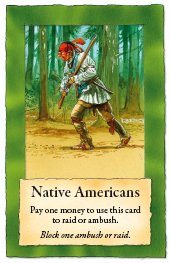
Your opponent now has two options for a response. He can block the raid or can concede defeat. Blocking a raid is similar to blocking an ambush: just play a card that says it blocks a raid. These will be native americans, rangers, coureurs de bois, and fortification cards. In addition they can play the card corresponding to that location to block the raid as well. Conceding defeat of a location with a cube means you take the cube. Conceding defeat of a location with a disk means you take the disk and he puts a cube down in that location. The disk is worth 4 points instead of 2 which is good for you, but he gets to keep using the associated card going forward which is good for them. You do get 2 actions a turn so it is possible to spend both of them raiding the same place twice. First for the disk and then for the cube! 6 points!
Raiding is a tricky thing to evaluate. It costs a lot of money to pay for all the native american uses you need to beat through anything resembling a competent defense. A meticulous opponent can actually become immune to raids entirely since you can't raid a fortified location and you also can't raid beyond a fortified location. I don't like focusing on the raiding game as I find it bogs your deck down if it fails and it can be too easily countered. That said, sometimes your opponent doesn't position himself to counter it quickly and you can deal a crippling blow to your opponent.
A strategy Andrew came up with for the British is to quickly expand towards Quebec and try to successfully raid it twice. If you manage to do so you turn the Quebec card off which has the only settler icon in the French deck. If you follow that up by buying the two neutral settler cards the game is practically over. The French can't put any disks into play which limits their scoring options. They can't settle any locations with a settler icon on them which further reduces their ways of scoring points. Most importantly they can't settle Pemaquid or Albany which means they can't attack a British capital. Since he told me about it I've managed to pull it off a couple times and my opponents have conceded after a couple turns when they realized they have no chance to win anymore.
Another thing you can try to do is raid away Trois Rivieres. Because of the way connections work down there everything west of Quebec connects through Trois Rivieres so you end up turning off every card in the French deck that branches west. Sometimes this will be half or more of your opponent's deck!
Just like with ambushing the French have a large advantage in the raiding game. Their militia can block raids. They have an empire specific native americans card. They have two priests to the British one indian leader. Another advantage the French have that isn't immediately obvious is they start with more points in play. Raiding, if it works, is one of the fastest ways to end the game and they start in a position that wants an early end to the game. I have been in a position as the British where I could successfully raid a location but would lose the game if I did since I'd trigger end game while having fewer points than my opponent.
I do frequently find myself getting into a raid based endgame as the French. Games I play will often have a long, drawn out siege in one location. We'll both have a very thin deck and my opponent will buy neutral native americans cards to try to stop my ambushes. I'll buy a priest and work to take all his native americans. Eventually the siege will end (typically in a British victory) and my back will be against the wall. The British will have a huge military deck and I'll have a huge native americans deck. So I'll ambush a few times to get him under control and then raid with the rest of them. It seems to work reasonably well. You just have to be very careful to have a huge stockpile of cash leading into that stage of the game. I have lost games where I have no money and a hand full of (now useless) native americans cards.
It's very important to track your opponent's hand and deck contents if you're going to try to pull this off. Wasting time and money on raids when they have the location card in hand for the block is painful. Sometimes tracking their hand can help in that you want to make them block with a location! (If they need that location card to launch a siege on Quebec, for example, and you just want to buy some time!)
Like everything else in the game raiding can be very powerful if your opponent doesn't make the right moves to block it. Raiding might even be the swingiest of all the strategies since it can completely destroy your opponent's ability to play the game if implemented properly but is also the easiest plan to counter. Fortification cards are cheap to buy and relatively cheap to put on the map. It's worth playing around with for sure but personally I've found it's a little too easy to block.
Thursday, March 08, 2012


Wednesday, March 07, 2012
League of Legends: Twisted Treeline
For a variety of reasons which I may get into in a future post my team has started playing ranked games on the 3v3 map in League of Legends: Twisted Treeline. There are a number of key differences between this map and Summoner's Rift (the default one) and I wanted to muse a little about those differences and how they might impact champion selection strategy.
The first change is that the map is significantly smaller. I decided to test out exactly what the difference is by timing how long it took to walk in as straight a line as possible in each dimension on each map.
SR- 39 seconds horizontally, 39 seconds vertically, 62 seconds diagonally
TT - 36 seconds horizontally, 21 seconds vertically, 43 seconds diagonally
So the usable area of the map is a little smaller east to west and about half as big north to south. This means 'global' abilities which cover the entire map are less potent since they're cutting down less distance. Summoner teleport, Gangplank's ult, etc all feel less powerful. On the flip side abilities where large but not infinite distances matter should get better. Twisted Fate and Ziggs have ults with a huge range and they're probably always going to be able to connect with them on TT while they have to walk a bit to use them on SR.
The second change is the map is 3v3 instead of 5v5. This means massive area of effect abilities are devalued relative to single target abilities. Amumu's ult is awesome because it shuts off 5 people for 2 seconds each. If it can only hit 3 people it's still pretty good but not as fantastic. On the flip side single target heavy damage characters should be better.
Dedicated healers should be worse since you're giving up a larger percentage of your team's damage in order to get them. Self healing, on the other hand, gets better when the other team can do less damage to you. Someone like Dr Mundo could be unkillable with 2 or 3 people on him! In a 5v5 game he's not great because you get the whole team to focus him or no one hits him and his massive healing doesn't really help out. Warwick seemed somewhat similar though not nearly as extreme.
The third change is in the number of turrets on the map. In SR each team has 11 turrets across 3 lanes and typically they all have to get killed before you win the game. On TT each team has only 5 turrets in only 2 lanes. Again they'll all tend to get killed but it still means a lot less pushing to get a win. Winning a team fight generally nets you a turret kill and you only need half as many of those to win at TT than at SR! This means games should take less time to complete which means champions which start weak but build into a strong late game feel worse. If the game never reaches the same 'late game' then that champion will simply never be strong at all. By contrast champions which start off strong and then tail off seem a lot better on TT.
The fourth change is a substantial rework of the neutral monsters in the jungle. Perhaps the biggest change is the complete lack of a blue buff. SR has two blue buffs, one for each team, and teams will often choose their junglers and caster champions based on the existence of this buff. It gives a huge mana regeneration buff which is what allows some champions to function. I can't imagine Amumu killing at anything resembling a reasonable speed without access to blue buff, for example. Dragon and Baron got combined into a single monster that's between the two in difficulty, grants global xp, and gives a 1% damage per level buff globally. There's a single red buff monster that spawns incredibly close to the bottom lane making it a bit of a rsiky proposition to go for early. Beyond that there are 6 smaller camps which actually spawn randomly between two options. There are 3 tiers of camps and the highest one has two new short term buffs. One gives 30% movement speed and the other gives 20% attack speed and 10% cooldown reduction. Both are useful but not game changing like blue buff.
With all these changes should you even have a jungler in 3v3? It's a similar question in 5v5 where if one team has a jungler and the other doesn't then you get a big advantage in terms of available gold/experience for your team but have the disadvantage that one of your team has to fight 1 against 2. Being able to take and use the blue and red buffs in the standard game are so strong that the metagame has evolved to the point where every team has a jungler and you just have a second 1 against 1 lane. 3v3 so far has been different in that we have yet to play against a team with a jungler. There's no blue buff to control and the single red buff is right beside a lane so buff control isn't a reason to run a jungler in TT. On the other hand the experience and gold advantages still exist assuming you have someone capable of surviving 1 against 2. Even if you don't have someone jungling it still feels like having someone running smite helps a lot. I've only played a dozen games or so and already I've stolen both dragon and red buff from the other team with smite.
Lately we've been running a jungler and it feels like we're a little weaker in the early game (the 1v2 lane has to play really passively until they get pushed back to their turret) and often fall behind in player kills while staying ahead in creep kills. Then in the mid game we seem to surge forward and come back. I'm sure there's more going on than just having a jungler of course but it feels strong.
A fifth change between the maps is how mazey TT is. There are trees and cliffs all over the place making it take longer to move from one spot to another than it would seem. Unless you're playing a champion that can ignore walls in which case you have a ton more mobility than other champions. The first game I played on the map I was Tryndamere and his ability to spin through walls was huge. He's been banned in pretty much every game since but it still seemed like a really strong ability to have. Shen, Kassadin, Ziggs? Can they make it through the same walls I wonder? We played one game against a Fiddlesticks who was ulting over the walls from seemingly nowhere which seemed pretty good.
Last night we played 4 games with the team Ahri, Sion, Warwick and won them all. Ahri slots in as the high damage early on character and takes a 1v1 lane. She has a good CC ability in her charm and has an ult which allows escaping from 3 man ganks which seem particularly prevalent in TT. Sion goes 1v2 and tries to survive by farming at his turret with his shield. He also has a good CC ability with his stun. Warwick hangs out in the jungle giving the team the early experience advantage and seems well suited to the map in general. His attack speed buff makes for relatively quick turret destruction after a team fight victory or even if the other team is just out of position. His ult destroys a single target which is stronger in 3v3 than in 5v5. And he has a lot of self healing which also works well in a smaller format. I'm still building manamune (especially with no blue buff on the map) and it seems to be working out fine.
I am curious about building a full pushing team. Run someone like Heimerdinger and just keep the pressure on non-stop at a turret. You'd probably need someone with a taunt to protect him so maybe Shen who can also split-push and then ult in? He could also jungle maybe? And then round out the team with someone who does physical damage and can be a tanky pusher? Shyvanna maybe? Nocturne? Warwick even? Irelia? Tristana? Maybe skip the physical damage and just run Morgana in one lane and Heimerdinger in the other? You'd want wards to make sure you don't get ganked by 3 so maybe Teemo's mushrooms? (Or just actually shell out the bucks for wards...)
I'm really liking the map. The games are quicker and it's enough different from the standard game to be interesting while still having enough in common to have skill transferal.
Tuesday, March 06, 2012
Final Fantasy IV: Zeroedmus
Last night saw the conclusion of my Final Fantasy IV game. I cleared out most of the final dungeon (I don't know of any paths I skipped but I didn't get all the treasure so I must have missed something) with relative ease. I did almost die to the mini-boss which puts a 10 second Doom timer on the entire party but I barely took him out with 1 second left. Hurray for the Nuke spell!
Zeromus himself came close to winning once but ultimately the fact he has no physical attacks spelled doom for him. He was beating the tar out of Edge and Cecil with his spells but was barely hurting Rosa and Rydia and they're the ones with the healing spells. Cure4 wasn't good enough to keep up but Asura was a full heal. Edge didn't even run out of ninja stars to throw at him before he died and I didn't buy more of them so I just used what I found in chests over the course of the game. I would have been annoyed if I'd died since the save point was so far away but ultimately the fight wasn't all that hard.
I think the game clock in the game was around 14 hours when I finished. I died once to Bahamut but that means I couldn't have spent more than 15 hours total playing the game. 82 days to put in only 15 hours. That's a long time to plow through what I've always said is my favourite game. This time around I often found myself falling asleep while playing! I got frustrated with the ATB system multiple times as well. Did the game just not age well? Have I been spoiled by the iterations that came later?
I don't know. It's been around 8 years since I last played the SNES version but even then I'd played FFX and all previous games. Maybe I've been subconsciously comparing it to the DS version?
Maybe there's just nothing new to experience? There's no console RPG I've played anywhere close to as many times as I've played FFIV and there's not exactly a lot of deviation in how the game plays out. There are a few side quests that can be done but the characters are always the same and I mostly do everything in the same order.
That said the story is awesome. The music is awesome. I love the character and enemy designs. It was my first RPG as a kid and will always have a special place in my memory as a result. I'm slotting it in as #1 on my marathon page so far. But will it be able to hold that spot for long? Coming up shortly is a run of games featuring V, VI, VII, and Tactics which all could compete for the crown I'd just assumed would stay with IV when I started this up last year. But first we have Legend III and Mystic Quest!
Monday, March 05, 2012
Marking Schemes
If you're a true gamer at heart you're constantly looking at life through a particularly odd lens. How do I play? How do I win? It doesn't matter if normal people could possibly imagine something as a game... To you everything is a game and you need to win!
MITx's first course, Circuits and Electronics, started today. The first thing I did after logging in to the system was check out the syllabus and find the marking scheme. This was always the most important thing to do for a class back when I was still in school. It lets you know what the professor thinks is important and where you're likely to need to focus your energy.
I can remember having a class with 10% for assignments, 20% for the midterm, and 70% for the final. There were 10 assignments so each was worth only 1% of the final grade and they were each likely to take 10ish hours to complete. By contrast studying for the final was only likely to take 10ish hours on its own and would be worth 70 times as much. These numbers are really out of whack! It's here that you need to figure out what exactly you're trying to accomplish with the class. Are you trying for the highest mark possible? Do you just want to barely pass? Do you want a merely good mark? Is your goal to learn the material? Will pounding away at long assignments help understand the course or will it merely occupy a lot of time?
Personally I found I learned things just fine from a book and didn't have a lot to gain from doing overly long assignments. It depended on the class, of course, but the one referenced above? I didn't do those assignments. I wish I could say I spent the saved time on something more valuable than sleeping and playing bridge but that would be a lie. On the flip side I remember spending a lot of time on low value assignments for some of my programming classes because I enjoyed doing them and thought I did have something to gain by slogging away at them.
At any rate, what is the marking scheme going to be for 6.002x? 15% assignments, 15% labs, 30% midterm, 40% final. There are 12 each for assignments and labs where they're only counting your top 10 scores. The claim from the announcement is that the whole course should only take 10 hours per week which includes the assignment, lab, watching the lectures, and reading the book. This seems like a split more in line with actually forcing people to do the work each week than my anecdote. The assignments should be substantially shorter and worth more. The final is worth significantly less. And the threshold for success is higher, I think. You need to get at least a C to get the credential for the course. I don't know how they're translating numbers into letters but I think 63-66 is a C. (Looking at the course profile it seems 60 is a C.) So it's not possible to pass with only doing the final. Midterm and final combined could do it but they've come right out and stated that problems from the assignments/labs will be on the midterm and final. Also everything is being marked by a bot and not real people so there's a lot to be gained by doing the work to see how the bot will mark things. So even if I was interested in just doing the least work possible to get a credential I'd probably want to do some of the assignments anyway.
Of course, I am interested in actually playing around with their lab environment! So even if optimally I should game the system by skipping the labs I'd be trying them out anyway. I'm just happy to see that's probably not the case. The assignments can be done with other people and the exam is a solo affair so it makes sense to have it be worth proportionally more per time invested but the 70:1 ratio from some of my older courses was just too much. This course feels, on the surface at least, like it has a better ratio. Time will tell if I end up wanting to do even 10 assignments let alone all 12.
Sunday, March 04, 2012
World of Warcraft: Questing on Rails
The questing experience in World of Warcraft changed drastically with the release of the Cataclysm expansion. Back in the 'good old days' most quests were self contained. There's a dude who wants you to kill some deer. As soon as you're in level range he wants you to kill some deer. After you kill some deer for him he gives you some experience and then just stands around looking stupid. Nothing changed because you killed some deer. Every now and then you'd run into a long chain of quests that had to be done in order but the deer killing guy wasn't involved in those and didn't care if you did that chain or not. With Cataclysm that changed and they made entire zones into one huge chain. There'd be a guy who wants you to kill some deer but he'll only ask you to do it after you do a seemingly unrelated quest to kill some fire elementals. Further along is a guy who wants you to sift through poop but for some reason he only wants the poop sifted through after the deer have been killed. Blizzard also made heavy use of 'phasing' during these chains so it's entirely possible you can't even see the poop guy at all until you've killed deer.
On the one hand the idea is pretty neat that you'd be playing through a single contained story. With phasing the world actually changes (for you, anyway) as you complete quests. Some people like it, some people hate it. I've leaned on the side of not liking it. Up until today, anyway, when I've seen how rails questing can impact my Ironman character. Now I'm firmly against the whole rails concept as there are two consequence which are going to hurt me in my journey.
The first problem is the inability to skip dangerous quests. Maybe my poor undergeared and untalented shaman simply can't kill deer at all. Maybe they have nature resistance or something, I don't know. In the old way I'd just abandon the deer quest and move on with my life. Go and sift through some poop or something more appropriate for my skills. Now? I risk my life trying to kill the deer or I find an entirely new zone to quest in. I lose everything in my current zone after the deer quest because for some reason they're all dependent on killing deer.
The second problem is the inability to just drop in on the middle of a zone. My thinking is that once I gain a few more levels I'm going to have to search for quests that are barely green in order to find things I can plausibly do. This shouldn't be a problem since the game is filled with tons and tons of quests. But if I can't access most of those quests because they're behind other quests I could run into a problem. Some quests could be locked behind dangerous quests I want to skip. Others are locked behind quests that are too low to be worth experience at all.
I haven't leveled a new character since Cataclysm launched (well, other than solely in dungeons) so I don't know if the rails problem is going to infest every zone but it is certainly the case in Azshara so far. I was given stealth in order to do a quest today which really worried me. I had to sneak past some elites which were 5 levels higher than me. If they saw me I was dead, guaranteed. But I didn't know how good the stealth was going to be. A druid trying to stealth around would be screwed for sure, but is this stealth better than that? Maybe this quest was designed to teach people how bad stealth can be so they stop whining about 'overpowered' rogues? But if I didn't do the quest I was done with the zone. I could probably try the Barrens instead? But I was right here! Ultimately I decided to risk it and lived so all is well. (And all that stealthing made me crave playing Metal Gear Solid again...)
I'm up to level 15 which slots me in as the 89th highest living shaman. Woo!
Saturday, March 03, 2012
World of Warcraft: Drnickiron!
The 7 day trial offer from Blizzard expired yesterday so I finally signed up for it. Everything seemed strange on my old main, Recolada, so I quickly logged out to start my ironman character. All my character slots on Vek'Nilash are full and I didn't want to worry about deleting one so I went back to my first server, Zul'Jin, to start up. I'd decided to play a shaman so the first question was which race to play. Passive and active damage buffs seem like they'd be important when you're playing without talents or gear and I ultimately decided the 1% haste that goblins get coupled with their free blink-like escape and free rocket strike were too good to pass up. As an added bonus I've never started a goblin before so I'd get to see a new zone and quests.
Even in an area where I'm supposed to be in mostly white gear I found myself playing paranoid. I had a quest to kill a named monster at the end of a town. After killing him most of the town had respawned. Normally this would cause me to just run for the entrance. Probably I wouldn't die, right? And even if I did I'd probably still get to turn in the quest faster by dying and ghosting back than by clearing my way to the start. This time where death means game over I took it slow. I waited for the mobs nearby to finish respawning (so they wouldn't spawn on top of me) and then slowly made my way to the entrance killing everything in sight. As an added bonus I'd get more experience per quest which should result in being overleveled as time goes by. Which is really important later on when I should be in blues and greens but remain in whites.
I've made it up to level 12, which is good for 152nd place on the live shaman list, I think. (I had to count manually!) I worry that searing totem is going to end up aggroing something and getting me killed. Apparently I have to wait until level 30 to get totemic recall!
One cool thing I noticed is that my health bar would fill up with a teal colour when I started a heal on myself. This way I could see how much health I'd expect to have after the heal finished. Assuming that appears for people in my party/raid as well this seems pretty great. It would stop multiple people from healing the same person and would also let me know, as a Death Knight, if I need to worry about healing myself or if the healers have me covered!
Friday, March 02, 2012
A Few Acres of Snow: Ambushing
 As discussed last time a very strong strategy in A Few Acres of Snow is to focus on military power and just conquer the other player's capital. The British have an advantage because their available cards simply have more strength combined than the French cards. Given infinite money and time for both sides the British will just win any military fight. Those may seem like extreme givens but the way the game plays out they're actually pretty reasonable. In a straight military fight it takes pretty much the same amount of time and resources to defend as it does to attack and the British can manipulate the game state such that they can get a powerful money engine going quickly. The French can try to compete by making money and buying military too but they're guaranteed to lose that fight since they have no way to get an edge and their available cards are just worse. They can try to compete by ignoring military and trying to expand but if you don't try to defend you lose every fight the turn they announce it and there's no way I can see to expand in time. There is one other option to combat military power: ambushing.
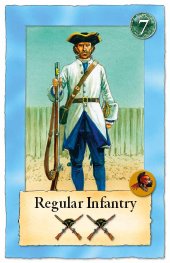
- They can reveal a card which is vulnerable to ambush (indicated by the Indian head shown on the regular infantry card on the right) and return it to their supply. They can buy the card back later if they have the money and want to spend and action but for the time being they lose access to that card. Any card in their hand or reserve can be hit.
- They can reveal their entire hand and reserve to prove that they don't have any ambushable cards at the moment. You don't get a refund of your card, buck, or action. They're just wasted. On the plus side you do get to know he precise contents of their hand.
- They can play a card which blocks ambushes. You'll note the Native Americans card above also says it can block ambushes. Note there is no cost to do so. They don't have to pay a dollar. They don't lose an action on their next turn. The only potential cost is they'll only have 4 cards in their hand for their next turn.
This seems like it could be pretty powerful, right? The only to fight a deck full of ambushing cards would seem to be a deck full of blocking cards? Well, not quite. It turns out there are another class of cards which help out and there are some negative side effects to the whole ambushing game.
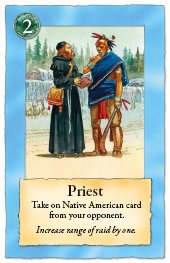
First of all, what is the other way to fight ambushes? Priest for the French and Indian Leader for the British. The two are functionally equivalent. You play one as an action and then if your opponent has one of the green Native American cards in their hand they have to give it to you. Otherwise they have to show you their hand. Both can be useful things to have happen especially since there is no monetary cost to playing the Priest. They can also be used in raids which will be covered in the next post.
What about negative side effects? Well, they clog up your deck is the biggest problem. The British deck functions best when it can draw a full merchant action every turn which uses up 3 of its 5 card hand. The French deck earns most of its money from the trader action which is best with a full 5 card hand of optimal cards. Every ambush card you draw reduces the chance of having an optimal money action which sets you further and further behind your opponent. Especially when you consider that the ambushes rarely even get you ahead in the first place...
What do I mean by that? Well, assume an optimal British engine. They make 6 bucks with their first action each turn. Their second action is to either buy a regular infantry for 7 or to play it into the active combat. Pretend you're the French and have unlimited access to ambushing cards. You spend an action and a buck to kill off their infantry every time they buy one. It took 1.14 actions to make the money and 1 action to buy the card so they're losing 2.14 actions when you hit an ambush successfully. Assuming you're making 5 dollars per action that's only costing you 1.2 actions which is a pretty good gain. Keep this up long enough and you'll have enough spare actions to actually win the game some other way. But now give the British a single blocking card. Now it costs you 2 actions and 2 dollars to kill their infantry. That's 2.4 actions which means you're actually losing ground! There is one ambush card which is free to play so you can get that down to 2.2 but it's still not helping your cause at all. Ambushing against a properly set up engine doesn't help. You can ambush after they win a fight, though, which can help.
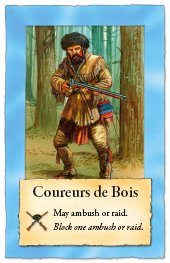
How do the different sides approach ambushing? Well, this is one area of the game where the French have a huge advantage. They have a blue Native American card which means that it can't be hit by the Indian Leader and that they have access to one more ambusher total. The French have access to 2 Priests compared to the 1 Indian Leader the British have. The French Militia cards actually block ambushes and raids while the British Militia are vulnerable to ambush. Beyond that they each have access to the 5 neutral Native Americans and they each have an ambusher that is free. (Rangers and Coureurs de Bois.)
Ambushing is a great way for a wise French player to abuse the mistake a British player makes but I have yet to find a way for ambushing to actually beat a top notch British plan. It can slow them down a little for sure, and I definitely need more experimentation to see if I can find a way to use that extra time to end the game as the French, but as it stands right now it doesn't seem good enough. The constant drain on gold by ambushing over and over just seems to be too much of a cost.
Ambushing does also give hand information and someone who properly tracks the contents of the opponent deck and hand will make better use of it than someone who doesn't pay attention. I keep playing against opponents who buy an Indian Leader when I don't have any neutral Native Americans, for example. Or people who ambush when I don't own a vulnerable card in my deck. Maybe they're doing it to gain the information themselves? More likely they're just making a mistake.
Thursday, March 01, 2012
World of Warcraft Updates
Thinking about the Ironman challenge has sparked a bit of interest in actually playing World of Warcraft again in a real way and not just in a silly 'do something crazy' way. Sthenno commented yesterday about upcoming (or maybe current?) changes to the priest class which are altering the way you get psychic scream which got me thinking about what else had changed in the game in the 10ish months since I'd quit. I've made a bit of a point of avoiding reading about the game after I quit playing for two reasons: I have lots of stuff to read about that impacts the games I am playing and because it could well suck me back in.
Well, I'm on the path to getting sucked back in anyway, so I figured I'd go and read some patch notes to see what was new. There are a lot of them so I decided to skip the class specific stuff (except for Death Knight) and just see what cool overall stuff might have changed. Here are some of the highlights that I've run across:
Stratholme - Postboxes no longer require keys to open, because really, who locks their postboxes anymore when they're all undead? It's just people sending coupons for brains anyway. {I just found this to be really amusing.}
Bind on Account stuff - Apparently can be mailed to other accounts on the same Battle.Net login which is cool. And you can mail stuff to different factions too?
Archaeology - Added new rare items (I wonder if I should look them up and add them to my post?) and made it so you're less likely to get dig sites if you have all the rare stuff. Making it more likely to get the Tol'Vir stuff I guess!
Crowd Control - Many crowd control abilities no longer cause creatures to attack players when they are cast. The creature will not attack the player when the crowd control wears off, and nearby creatures will not become hostile to the player either. {AWESOME!}
Raids - Holy cow did they ever nerf the raids we were running when I quit. For example: Nef adds falling over after 33 seconds instead of 50 seconds is such a huge change to the difficulty of that role. The kiter had to pretty much play perfectly to win before but now they'd never stack up enough damage to kill you if you just turned around and ran the whole time. Of course with Nef himself having 20% less health and doing 20% less damage that wouldn't really matter.
Items - If a player wins a Need roll under the Need Before Greed system on a Bind on Equip item, the item will become Soulbound to that player. The item will remain unbound if won via a Greed roll. {Nice. Now someone ninjaing all the BoEs can only vendor them and can't get a lot of cash on the AH.}
Call to Arms - Apparently they set it up so the rarest role in a 5-man group gets extra loot for signing up. So if there aren't enough people who want to tank a heroic the game starts bribing tanks to queue up. If there are enough tanks but not enough healers then the healers get an extra something for playing. It sounds so simple but it seems fantastic. Apparently it reduced queue times for DPSers from 45 minutes to 15 minutes when it came in because more people were willing to tank if it meant more stuff. Like a very unlikely shot at rare mounts! I don't know that it would have worked on me (I hate people so much) but it probably would have tricked me into going a few times for points as well. And I can really see how less antisocial people would really fall for it.
Subscribe to:
Posts (Atom)