Part of being a GM at the World Boardgaming Championships is agreeing to submit a recap of the tournament for inclusion on the website and in the printed yearbook. Personally I read every recap for every event every year so these things have a lot of importance to me. And yet earlier this week the convention director for WBC had to send me an email because I have, in fact, missed the deadline for submitting my recap for A Few Acres of Snow. Because I'm a lazy bum, and a terrible GM. The deadline doesn't actually mean anything because there are no immediate consequences and if there's one thing I've learned about myself over the years I'm either going to get things done right away or they're just going to slip my mind and get left to the absolute last minute. I don't like that this is true, but I'm 'absent minded' and that doesn't seem likely to change. It's why I had to go to a 'post once a day' format for my blog (even if I've fudged what a day means) because when I just posted when I felt like it I never actually posted.
At any rate, there is a second deadline for submitting a recap, and if I don't hit that one then my event loses a prize level for next year. There's even a third deadline, and if I don't hit that one then my event loses a status level for next year. I'm pretty sure A Few Acres of Snow is sunk by attendance issues anyway, but I still want there to be a recap and if somehow it does get back in the century I really want it to have 3 prizes instead of 2. Whoever gets 3rd place will be glad I did! (Which was me this year!) I really don't want it kicked out entirely for next year. Two events which I'd previously won got the boot last year and that made me sad.
The first step to getting this done is parsing through all the data I have on the bidding system since that's probably going to be the key thing discussed in the recap. I had every game fill out a form indicating the bid and result of the game, so I need to enter that into a spreadsheet...
Having now done so, I have data for 25 games. 14 of the games were French wins, 11 were British. The 14 French wins came from an adjudication, a cube out, 8 disk outs, a spoils win, and 3 military wins. The 11 British wins were 2 disk outs, 4 military wins, and 5 spoils wins. One of the disk outs there was a French disk out with the British having the high score. (This was my semifinal game, where I played my last disk out and Nick Henning had one chance to start a siege to keep the game going and did. Winning that siege swung the point total in his favour.) The interesting thing compared to last year is the military win ratio with the French winning almost as many games by military as the British did. I think part of the problem is going to be with the spoil wins since I'm pretty confident the British spoil wins were earned through military means and the French one was likely through raiding.
How about if I split out by bid? Well, bidding doesn't seem to matter. Twice the bid was for 7, and each side won one of the games. Twice the bid was for 6, and each side won one of the games. The British had a 3-1 lead when the bid was 5. The French won 11 of the 17 games when the bid was 4 or lower.
My assertion has always been that the British will win every single game with no bidding system, but the numbers don't back that up at all. If anything the stats make it seem like the French win with no bidding system while the British win once some bidding happens. And that might make sense if people were bidding for the French, but every single bid was for the British!
What I think is actually overshadowing the bidding system is the large difference in skill levels between some of the players who showed up. I had several people play their first game after the demo, and I suspect most people in the event had played only a handful of games in their lives. I've played 315 games on Yucata and a few more in person and I think the two finalists this year had played quite a few games against each other over the past year. Someone good is going to beat someone bad regardless of side choice. And when two newer players play against each other the French have an overwhelming advantage because they start with such a huge point and military lead. The British have an unstoppable line of play to overcome those advantages, but if you don't take that line of play you're in trouble.
If I restrict my numbers to just the last three rounds I have 6 games where the British won 5 of 6. The bids still don't make a whole lot of sense, with there being British wins at 1, 2, 3, 6, and 7. The French won a game at 4.
What I do know, from watching and playing the games, is the 6 and 7 wins for the British were both very close. In both of those games the French were able to play all their disks. The British had to start an attack on their last turn to win. The British had one card in their deck to use to start that attack, and had drawn about half their cards on this shuffle. (And needed to also have a boat and some military cards.) Both games were probably close to 50-50 on the last turn of the game to see which side would win, and it just happened that both times the British got the card they needed. I know in my game at least I put those 7 free draws to good use just getting to the point where I could disk out, and the British would certainly have been able to launch their attack if I didn't have them.
So is the right bid in the 6-7 range? Would having an 8th draw have saved me in my game for sure? Would it have swung the odds a little more in my favour? What about the 9th or 10th? The French did win a semifinal game with a bid of 4, so maybe the number should be lower? Was the play just different at that table? The same French player didn't win the finals with the bid at 6. So that could be a skill difference, or the whole 4-7 range could just be enough to introduce some randomness. It certainly feels like there is probably a bid range where neither side is guaranteed to win which is not something I was convinced was possible after last year, and which may be enough to convince Robb that this should actually be a WBC event. If only enough people had shown up with copies of the game so I didn't have to turn so many people away. Losing almost a third of our attendance in a year where attendance was up in general is probably a death knell for the event.
Well, now I have the data in a reasonable spot. Now to actually try write a reasonable recap for the website...
Showing posts with label A Few Acres of Snow. Show all posts
Showing posts with label A Few Acres of Snow. Show all posts
Thursday, September 12, 2013


Wednesday, July 31, 2013
2013 WBC Day 3
Monday had the A Few Acres of Snow demo at 11am as the first thing on my agenda. I didn't want to sleep through it, so I set the alarm in the room for 10am. I ended up actually waking up more around 9 or so, frozen solid despite Pounder's extra blanket, so I once again jumped into a hot bath. Which helped a little while I was in it, but I didn't like getting out of it. At some point Robb started yelling about how it was 11am and I was missing my demo. This seemed odd since I was pretty sure I wasn't in the tub for more than 2 hours. It turns out the alarm had gone off at 10 and confused him and somehow that made him think it was 11 or something. He was probably still sleeping. And apparently the alarm is very hard to turn off.
Anyway, I was up and about and went to the demo area to set up. In retrospect it was probably a mistake to show up to the demo area so much earlier than my start time. I had time to set the game up, which was nice, but then people started showing up. I could tell that making small talk was what was supposed to be going on, and that as the person 'in charge' of the table I was obligated to stay on top of that, but that's just not something I can do. Especially when sick. So I just sat there being antisocial. Eventually enough people showed up that they gave up on me and started talking amongst themselves instead. Yay?
Did the demo in about 45 minutes. I missed some things that came up later (disconnected locations becoming unplayable, the actual legal attack path) but it went reasonably well. I was very susprised at how many people showed up to the demo. Probably in the 15-20 range. WBC is still mostly stuck in the old idea that the convention really starts Tuesday at 6pm so things that run on Monday don't really have that much competition I guess. There was one other demo going on for a much longer, more hardcore wargame. So I guess A Few Acres of Snow was the casual option for the day. Several of the people from the demo came to play in the first round, which was good.
What wasn't good was the mix of people who showed up for the first round. 24 people showed up to play with 3 mulligan round losers showing up, for a total of 29 people for the entire event. Down a little from the 33 of last year, but not down by too much. But of those 24 people only 6 had a copy of the game, which meant 18 people without a copy. I had my copy some people could use, but that still left 10 people with no game to play. One guy knew someone who had a game lying around (one of the mulligan round winners as it turned out) so that took care of 2 more people. Robb ran off to check the open gaming library but no copies were there either. So I told the remaining 8 people that if they wanted to check back in an hour I'd start games there on any boards that had finished up and were available for use. 3 people ended up coming back in an hour and one board was opened up so I got to squeeze 2 more people into the tournament. 6 people got turned away, leaving only 23 actual entrants. My suspicion was that we barely made it into the century last year and probably could have snuck back in with 29 people playing but falling down to 23 is probably a death knell. If only more people owned the game!
Because of all the hassle with looking for games I didn't have good timing down on the rounds. The rounds are supposed to be two hours long. Last year I think only one game went long, or if more did the GM did a good job of controlling them. I did not. Multiple games were brushing up against or going over the 2 hour mark. But I didn't know exactly when people started, and I didn't really know what to do about it. The problem with A Few Acres of Snow is the optimal winning strategy for one of the sides basically ignores victory points. So adjudicating a game based on points on hand is really bad if the British are trying for the auto win with a military victory. Officially you need the GM and both assistant GMs to adjudicate a game to make sure it's as fair as possible, which makes sense. But both my assistant GMs skipped the first round entirely since they won the mulligan round! Pounder also took off after losing in round 2, so I didn't have two assistant GMs after that. I ended up giving most of the games that went long extra time by ignoring them while assigning matchups for the winner of those games. That meant people got to get playing the next round sooner unless they were matched up against a slow winner, but it also meant the rounds got a little out of sync. At other Nick's suggestion I eventually randomized out a whole bracket and posted it so people would know who they were playing in the next couple rounds which made sense. I was trying to avoid doing that because I needed to award byes and I needed to make sure mulligan round losers didn't meet again until the finals but only one mulligan round loser managed to win even a single round of the main event so it ended up being pretty easy.
After all the shenanigans with the half round start and such I ended up with 13 people advancing to round 2. This meant 6 games and 1 bye, followed by 3 games and 1 bye. At WBC you have to give byes at late as possible in order to keep as many people playing as soon as possible. You also have to give byes preferentially to previous winners. This meant I had to give myself the bye in the round of 13 and someone who wasn't me the bye in the round of 7. I shuffled up 6 cards and had other Nick give me a number from 1 to 6. This assigned the bye to Kevin (last year's 3rd place and the guy I beat in the mulligan round) which meant I could build the bracket out with me on the other side from him and just assign the other 5 cards at random.
I was matched up against one of the guys from Quebec who come down for WBC. He let me play as the British for a bid of 1, which seemed really low. He started a quick siege of Pemaquid and I countered by thinning my deck, staying even in that fight, and starting a siege in Port Royal. I made one small mistake by letting him ambush me twice while he still had his Siege Artillery in his deck which let him threaten to win either fight if I commited anything to the other one. What I should have done was not cared about that, put pressure on the Port Royal fight, and kept him from getting off the ambush at all. Instead I guaranteed a win in Pemaquid but lost 7 dollars from his successful ambush. This also meant my bad cards and his good cards recycled into the decks. I was still able to pull off a quick siege and victory in Louisbourg but he got off a couple more ambushes in the meantime. I didn't have the strength to keep going. I tried anyway, jumping into a fight in Gaspe, but ended up losing that one. (Gaspe was still a cube and I wanted to keep him from putting a disk on it while I built up an army again.) Ultimately I bought an Indian Leader and managed to use that to stop the siege bleeding. I then bought some more guns to even us up. His deck was pretty watered down with lots of indians and guns. So was mine, to be fair, but I felt like I had inevitability on my side. Eventually I started a siege in Gaspe again, but only put a couple boats into it to start. He pulled out his reserve and overcommitted to the fight, guaranteeing his victory but taking several military cards out of circulation for one shuffle of his deck. I felt like that was going to be enough of a window, so I jumped into a fight in Trois Rivieres. Note I waited to jump into Gaspe until I was about to reshuffle, in order to be able to attack quickly again after losing the fight. He had no response to the fight in Trois Rivieres since he couldn't redraw enough guns fast enough. I think he had enough in his deck, but couldn't bubble them to the top in time. I won that fight and pretty much won the game as well. He didn't concede so I went through the motions. Attack Tadoussac, win. Raid Montreal from Trois Rivieres. Have 12 points in spoils and end the game that way, with a massive point lead.
In the middle of this game other Nick brought to my attention that one of the other games was going really long. It was a round 2 game still! The last one of those to start thanks to not adjudicating round 1 games, but it was going really long. And they were cheating. So I went over and pointed out the illegal move (putting a disk into a location not worth points) and then looked to see if the game was going to end soon. They'd been playing for way more than 2 hours at this point and weren't anywhere near any of the victory conditions. So I ended up counting the points. The French player, unsurprisingly, was in the lead. But I couldn't see any way to adjudicate the game other than give them the win. The British player hadn't won any fights at all and had bloated his deck with junk so even if he could win with a strategy shift and another 2 hours I couldn't give it to him. I wanted to get other Nick to concur but the British player said he thought the ruling was fair and gave up.
The top 4 shook out to be someone from the bonus round 1.5 game and last year's top three. Myself, other Nick, and Kevin. I was playing other Nick in one semi. He won the randomizer to make the first bid and started with 7 for the British. Here was my thought process... I knew other Nick and Kevin played the game together a lot. I knew they used the WBC bidding system in their games. I saw how close Kevin came to beating me in the mulligan round with a bid of 5 when he failed to use any of the actions. So I was a little worried that 8 for the British was going to be just too high. On the other hand I haven't played much at all, and I was sick, and I know my British game is better than my French game. Maybe I should have bid higher but I decided to just run with the French and see what would happen.
I ended up with a terrible opening hand and used one of my bid actions on the first turn. This let me start a siege in Pemaquid. I was then able to settle Halifax myself and start disking things up while keeping that fight going. My plan was to get close enough to ending the game by the time he broke out of the fight that I could use ambushes to keep him from getting beyond Louisbourg before I could win. Right as he was going to win the fight in Pemaquid I had a decision to make... Spend 7 dollars on some guns to slow him down as he tried to break out, or buy a settler and end the game one shuffle through my deck earlier. At this point I still needed to upgrade Montreal, Fort Frontenac, and settle and upgrade Oswego. I went with the Settler and used a bid action to reshuffle or something. I had used a couple more bidding tokens to get out of some awkward hands and thought I was in a reasonable position.
Other Nick started a fight in Port Royal with enough to win it and I had a choice. I had siege and regulars in my reserve so I could dig them out and throw them in. He had two regulars in his reserve though, so this was just going to eat up time and cost me the regular when I lost the fight. It would also use up all of my money and not get me any closer to ending the game since I would be spending cards from the reserve instead of from my hand. Instead I went with a double ambush. I killed off his reserve, got to draw 2 cards, but spent the money I'd need to play the siege artillery myself and lost the fight in Port Royal. Other Nick was very sad since it turns out he didn't have a settler icon in his hand. Prolonging the fight would have meant he'd draw one for sure, so this was almost certainly the right course of action for me. He'd need to cycle through his deck to get Boston again, and then either attack Halifax or settle Port Royal, and then cycle into that card to attack Louisbourg. I would almost certainly have enough tempo to end the game before all that could happen. Yay!
Then he attacked Halifax with the Pemaquid card. Huh. He'd bought a governor but he'd only ever removed St Mary's from the game. He kept Pemaquid around for some reason (he had upgraded it to a disk for 2 points prior to this, so he probably just didn't have it in hand when he used the governor) and was able to use it to start another siege on this run through his deck. I'd spent my money so I couldn't properly defend this one either. Instead I spent all but one of my remaining bid tokens to upgrade Montreal, grab Oswego, and reshuffle. I was going to lose the fight in Halifax right away, but I was going to be able to end the game on this next go through my deck.
At this point other Nick stopped to count points. If he was able to start a fight in Louisbourg, win it, and settle it then he would have more points than me and win the game. Otherwise if the game ended before he could do it, or if he couldn't settle when he did, I would win the game. My first hand after the shuffle... No settler. His first hand... No Halifax. By this point I'd used my last bid token (to ditch the useless Port Royal card and get one card deeper) and was able to settle one of the two needed locations. His second hand... No Halifax. I was pretty much at the bottom of my deck but still no Quebec. I did some junky actions to cycle deeper. He was then able to start a siege in Louisbourg. I could have ended the game with a different card ordering this time through my deck, but it was not to be. I was able to pull back my reserve to threaten winning the fight in Louisbourg and also put out my last disk. Siege artillery was in my hand now, but I had no money. I burned home support to draw 1 worthless card because it would let me reshuffle and draw 1 new card. (No point in having a hand of Home Support, Priest, Siege Artillery, Louisbourg, and Trois Rivieres with no cards in deck. Much better to have 4 worthless cards and a random one!) I pretty much needed to draw home support and use it to make 3 dollars in order to use the siege. Instead Other Nick ambushed my hand and put something into the fight in order to win it.
On the plus side, I had topdecked Home Support. All my disks were in play so the game was going to end at the start of my next turn if he won the fight in Louisbourg. I had no military strength in hand, so that was going to happen. I needed to score 3 points (while keeping him from scoring any points himself) or I needed him to not be able to settle Louisbourg or I needed to home support into something to keep the fight going I guess. I did use home support, but got no military strength. On the plus side, I did get both Trois Rivieres and a Native American card. I could use Trois Rivieres to make a dollar and spend it on the native to raid! I still had that priest card kicking around so I could get a range of 3. Enough to just barely reach Pemaquid! It had a disk on it, so this would be a 6 point swing and would win me the game. Except he was able to block it. With the Pemaquid card that he never got rid of and which was presumably crippling his hand the whole time.
The fight ended, he had no way to score more points, and he won the game by 3. But it was very close. On the last go through both of our decks my deck was very badly ordered for me (but not too unexpected since I needed to draw 4 specific cards) and his was not ordered very badly for him (but also not too unexpected since he just needed to draw 1 specific card along with a mix of many other viable cards). He was probably in the 60-70% range to win, but it wasn't guaranteed. I'm sure that having 7 bid tokens made a huge difference in that as well. I had several garbage hands over the course of the game and I was able to keep taking good turns by being able to cycle through the chaff. I'm not saying I played optimally, or that he did, but I do feel like the bidding system made this game into one that wasn't a guaranteed British win.
I didn't get to see the other semi, but Kevin won. He faced off against other Nick in the finals. Other Nick started the bid this time with only 6 for the British and won the bid. Maybe he started with a higher bid against me out of respect? Or maybe he saw something I didn't about how our game went and decided I should have won with the 7 bid? I don't know! The game started out very differently as Kevin bought a very early settler card just like he did in the Mulligan round and went to work trying to burn the game out. Nick went to work winning with a military force, but he didn't get the governor as early as I do (or maybe not even at all this game) and kept having to take actions for 3 dollars instead of 6. He did eventually get rolling, and got to a very similar board situation. Kevin was about to disk out, but Nick had just won the fight in Louisbourg. It turned out Kevin was able to put his last disk into play when Nick was about halfway through his deck. If he'd drawn the Louisbourg card and a boat he'd win the game by attacking Quebec. Otherwise he'd lose the game on points. He had the cards he needed, and won. But once again, he was probably only like 60-70% to get it done. A far cry from the base game, where I still firmly believe the British will win every game.
Because I lost to the eventual winner I came 3rd. This was good, since the event has prizes to the top 3. I filled out my forms, submitted them to registration, got my 3rd place plaque, and went off to die. There were lots of games I would have wanted to play in a normal year later in the evening, but I really, really didn't want to play anything. I did find Robb and Pounder in the open gaming room playing Copycat which looked interesting. We went out for food along with the random dude who played Copycat with them. We went to Red Robin because I didn't want to get even more sick.
Afterwards they went off to do something and I went to the room to try to make a blog post. Somehow my computer decided it was happy to connect to the network but that the network couldn't provide internet access. Eventually I gave up. On the plus side I figured out how to turn off the air conditioning in the room and did that so maybe I wouldn't freeze as badly in my sleep that night.
Anyway, I was up and about and went to the demo area to set up. In retrospect it was probably a mistake to show up to the demo area so much earlier than my start time. I had time to set the game up, which was nice, but then people started showing up. I could tell that making small talk was what was supposed to be going on, and that as the person 'in charge' of the table I was obligated to stay on top of that, but that's just not something I can do. Especially when sick. So I just sat there being antisocial. Eventually enough people showed up that they gave up on me and started talking amongst themselves instead. Yay?
Did the demo in about 45 minutes. I missed some things that came up later (disconnected locations becoming unplayable, the actual legal attack path) but it went reasonably well. I was very susprised at how many people showed up to the demo. Probably in the 15-20 range. WBC is still mostly stuck in the old idea that the convention really starts Tuesday at 6pm so things that run on Monday don't really have that much competition I guess. There was one other demo going on for a much longer, more hardcore wargame. So I guess A Few Acres of Snow was the casual option for the day. Several of the people from the demo came to play in the first round, which was good.
What wasn't good was the mix of people who showed up for the first round. 24 people showed up to play with 3 mulligan round losers showing up, for a total of 29 people for the entire event. Down a little from the 33 of last year, but not down by too much. But of those 24 people only 6 had a copy of the game, which meant 18 people without a copy. I had my copy some people could use, but that still left 10 people with no game to play. One guy knew someone who had a game lying around (one of the mulligan round winners as it turned out) so that took care of 2 more people. Robb ran off to check the open gaming library but no copies were there either. So I told the remaining 8 people that if they wanted to check back in an hour I'd start games there on any boards that had finished up and were available for use. 3 people ended up coming back in an hour and one board was opened up so I got to squeeze 2 more people into the tournament. 6 people got turned away, leaving only 23 actual entrants. My suspicion was that we barely made it into the century last year and probably could have snuck back in with 29 people playing but falling down to 23 is probably a death knell. If only more people owned the game!
Because of all the hassle with looking for games I didn't have good timing down on the rounds. The rounds are supposed to be two hours long. Last year I think only one game went long, or if more did the GM did a good job of controlling them. I did not. Multiple games were brushing up against or going over the 2 hour mark. But I didn't know exactly when people started, and I didn't really know what to do about it. The problem with A Few Acres of Snow is the optimal winning strategy for one of the sides basically ignores victory points. So adjudicating a game based on points on hand is really bad if the British are trying for the auto win with a military victory. Officially you need the GM and both assistant GMs to adjudicate a game to make sure it's as fair as possible, which makes sense. But both my assistant GMs skipped the first round entirely since they won the mulligan round! Pounder also took off after losing in round 2, so I didn't have two assistant GMs after that. I ended up giving most of the games that went long extra time by ignoring them while assigning matchups for the winner of those games. That meant people got to get playing the next round sooner unless they were matched up against a slow winner, but it also meant the rounds got a little out of sync. At other Nick's suggestion I eventually randomized out a whole bracket and posted it so people would know who they were playing in the next couple rounds which made sense. I was trying to avoid doing that because I needed to award byes and I needed to make sure mulligan round losers didn't meet again until the finals but only one mulligan round loser managed to win even a single round of the main event so it ended up being pretty easy.
After all the shenanigans with the half round start and such I ended up with 13 people advancing to round 2. This meant 6 games and 1 bye, followed by 3 games and 1 bye. At WBC you have to give byes at late as possible in order to keep as many people playing as soon as possible. You also have to give byes preferentially to previous winners. This meant I had to give myself the bye in the round of 13 and someone who wasn't me the bye in the round of 7. I shuffled up 6 cards and had other Nick give me a number from 1 to 6. This assigned the bye to Kevin (last year's 3rd place and the guy I beat in the mulligan round) which meant I could build the bracket out with me on the other side from him and just assign the other 5 cards at random.
I was matched up against one of the guys from Quebec who come down for WBC. He let me play as the British for a bid of 1, which seemed really low. He started a quick siege of Pemaquid and I countered by thinning my deck, staying even in that fight, and starting a siege in Port Royal. I made one small mistake by letting him ambush me twice while he still had his Siege Artillery in his deck which let him threaten to win either fight if I commited anything to the other one. What I should have done was not cared about that, put pressure on the Port Royal fight, and kept him from getting off the ambush at all. Instead I guaranteed a win in Pemaquid but lost 7 dollars from his successful ambush. This also meant my bad cards and his good cards recycled into the decks. I was still able to pull off a quick siege and victory in Louisbourg but he got off a couple more ambushes in the meantime. I didn't have the strength to keep going. I tried anyway, jumping into a fight in Gaspe, but ended up losing that one. (Gaspe was still a cube and I wanted to keep him from putting a disk on it while I built up an army again.) Ultimately I bought an Indian Leader and managed to use that to stop the siege bleeding. I then bought some more guns to even us up. His deck was pretty watered down with lots of indians and guns. So was mine, to be fair, but I felt like I had inevitability on my side. Eventually I started a siege in Gaspe again, but only put a couple boats into it to start. He pulled out his reserve and overcommitted to the fight, guaranteeing his victory but taking several military cards out of circulation for one shuffle of his deck. I felt like that was going to be enough of a window, so I jumped into a fight in Trois Rivieres. Note I waited to jump into Gaspe until I was about to reshuffle, in order to be able to attack quickly again after losing the fight. He had no response to the fight in Trois Rivieres since he couldn't redraw enough guns fast enough. I think he had enough in his deck, but couldn't bubble them to the top in time. I won that fight and pretty much won the game as well. He didn't concede so I went through the motions. Attack Tadoussac, win. Raid Montreal from Trois Rivieres. Have 12 points in spoils and end the game that way, with a massive point lead.
In the middle of this game other Nick brought to my attention that one of the other games was going really long. It was a round 2 game still! The last one of those to start thanks to not adjudicating round 1 games, but it was going really long. And they were cheating. So I went over and pointed out the illegal move (putting a disk into a location not worth points) and then looked to see if the game was going to end soon. They'd been playing for way more than 2 hours at this point and weren't anywhere near any of the victory conditions. So I ended up counting the points. The French player, unsurprisingly, was in the lead. But I couldn't see any way to adjudicate the game other than give them the win. The British player hadn't won any fights at all and had bloated his deck with junk so even if he could win with a strategy shift and another 2 hours I couldn't give it to him. I wanted to get other Nick to concur but the British player said he thought the ruling was fair and gave up.
The top 4 shook out to be someone from the bonus round 1.5 game and last year's top three. Myself, other Nick, and Kevin. I was playing other Nick in one semi. He won the randomizer to make the first bid and started with 7 for the British. Here was my thought process... I knew other Nick and Kevin played the game together a lot. I knew they used the WBC bidding system in their games. I saw how close Kevin came to beating me in the mulligan round with a bid of 5 when he failed to use any of the actions. So I was a little worried that 8 for the British was going to be just too high. On the other hand I haven't played much at all, and I was sick, and I know my British game is better than my French game. Maybe I should have bid higher but I decided to just run with the French and see what would happen.
I ended up with a terrible opening hand and used one of my bid actions on the first turn. This let me start a siege in Pemaquid. I was then able to settle Halifax myself and start disking things up while keeping that fight going. My plan was to get close enough to ending the game by the time he broke out of the fight that I could use ambushes to keep him from getting beyond Louisbourg before I could win. Right as he was going to win the fight in Pemaquid I had a decision to make... Spend 7 dollars on some guns to slow him down as he tried to break out, or buy a settler and end the game one shuffle through my deck earlier. At this point I still needed to upgrade Montreal, Fort Frontenac, and settle and upgrade Oswego. I went with the Settler and used a bid action to reshuffle or something. I had used a couple more bidding tokens to get out of some awkward hands and thought I was in a reasonable position.
Other Nick started a fight in Port Royal with enough to win it and I had a choice. I had siege and regulars in my reserve so I could dig them out and throw them in. He had two regulars in his reserve though, so this was just going to eat up time and cost me the regular when I lost the fight. It would also use up all of my money and not get me any closer to ending the game since I would be spending cards from the reserve instead of from my hand. Instead I went with a double ambush. I killed off his reserve, got to draw 2 cards, but spent the money I'd need to play the siege artillery myself and lost the fight in Port Royal. Other Nick was very sad since it turns out he didn't have a settler icon in his hand. Prolonging the fight would have meant he'd draw one for sure, so this was almost certainly the right course of action for me. He'd need to cycle through his deck to get Boston again, and then either attack Halifax or settle Port Royal, and then cycle into that card to attack Louisbourg. I would almost certainly have enough tempo to end the game before all that could happen. Yay!
Then he attacked Halifax with the Pemaquid card. Huh. He'd bought a governor but he'd only ever removed St Mary's from the game. He kept Pemaquid around for some reason (he had upgraded it to a disk for 2 points prior to this, so he probably just didn't have it in hand when he used the governor) and was able to use it to start another siege on this run through his deck. I'd spent my money so I couldn't properly defend this one either. Instead I spent all but one of my remaining bid tokens to upgrade Montreal, grab Oswego, and reshuffle. I was going to lose the fight in Halifax right away, but I was going to be able to end the game on this next go through my deck.
At this point other Nick stopped to count points. If he was able to start a fight in Louisbourg, win it, and settle it then he would have more points than me and win the game. Otherwise if the game ended before he could do it, or if he couldn't settle when he did, I would win the game. My first hand after the shuffle... No settler. His first hand... No Halifax. By this point I'd used my last bid token (to ditch the useless Port Royal card and get one card deeper) and was able to settle one of the two needed locations. His second hand... No Halifax. I was pretty much at the bottom of my deck but still no Quebec. I did some junky actions to cycle deeper. He was then able to start a siege in Louisbourg. I could have ended the game with a different card ordering this time through my deck, but it was not to be. I was able to pull back my reserve to threaten winning the fight in Louisbourg and also put out my last disk. Siege artillery was in my hand now, but I had no money. I burned home support to draw 1 worthless card because it would let me reshuffle and draw 1 new card. (No point in having a hand of Home Support, Priest, Siege Artillery, Louisbourg, and Trois Rivieres with no cards in deck. Much better to have 4 worthless cards and a random one!) I pretty much needed to draw home support and use it to make 3 dollars in order to use the siege. Instead Other Nick ambushed my hand and put something into the fight in order to win it.
On the plus side, I had topdecked Home Support. All my disks were in play so the game was going to end at the start of my next turn if he won the fight in Louisbourg. I had no military strength in hand, so that was going to happen. I needed to score 3 points (while keeping him from scoring any points himself) or I needed him to not be able to settle Louisbourg or I needed to home support into something to keep the fight going I guess. I did use home support, but got no military strength. On the plus side, I did get both Trois Rivieres and a Native American card. I could use Trois Rivieres to make a dollar and spend it on the native to raid! I still had that priest card kicking around so I could get a range of 3. Enough to just barely reach Pemaquid! It had a disk on it, so this would be a 6 point swing and would win me the game. Except he was able to block it. With the Pemaquid card that he never got rid of and which was presumably crippling his hand the whole time.
The fight ended, he had no way to score more points, and he won the game by 3. But it was very close. On the last go through both of our decks my deck was very badly ordered for me (but not too unexpected since I needed to draw 4 specific cards) and his was not ordered very badly for him (but also not too unexpected since he just needed to draw 1 specific card along with a mix of many other viable cards). He was probably in the 60-70% range to win, but it wasn't guaranteed. I'm sure that having 7 bid tokens made a huge difference in that as well. I had several garbage hands over the course of the game and I was able to keep taking good turns by being able to cycle through the chaff. I'm not saying I played optimally, or that he did, but I do feel like the bidding system made this game into one that wasn't a guaranteed British win.
I didn't get to see the other semi, but Kevin won. He faced off against other Nick in the finals. Other Nick started the bid this time with only 6 for the British and won the bid. Maybe he started with a higher bid against me out of respect? Or maybe he saw something I didn't about how our game went and decided I should have won with the 7 bid? I don't know! The game started out very differently as Kevin bought a very early settler card just like he did in the Mulligan round and went to work trying to burn the game out. Nick went to work winning with a military force, but he didn't get the governor as early as I do (or maybe not even at all this game) and kept having to take actions for 3 dollars instead of 6. He did eventually get rolling, and got to a very similar board situation. Kevin was about to disk out, but Nick had just won the fight in Louisbourg. It turned out Kevin was able to put his last disk into play when Nick was about halfway through his deck. If he'd drawn the Louisbourg card and a boat he'd win the game by attacking Quebec. Otherwise he'd lose the game on points. He had the cards he needed, and won. But once again, he was probably only like 60-70% to get it done. A far cry from the base game, where I still firmly believe the British will win every game.
Because I lost to the eventual winner I came 3rd. This was good, since the event has prizes to the top 3. I filled out my forms, submitted them to registration, got my 3rd place plaque, and went off to die. There were lots of games I would have wanted to play in a normal year later in the evening, but I really, really didn't want to play anything. I did find Robb and Pounder in the open gaming room playing Copycat which looked interesting. We went out for food along with the random dude who played Copycat with them. We went to Red Robin because I didn't want to get even more sick.
Afterwards they went off to do something and I went to the room to try to make a blog post. Somehow my computer decided it was happy to connect to the network but that the network couldn't provide internet access. Eventually I gave up. On the plus side I figured out how to turn off the air conditioning in the room and did that so maybe I wouldn't freeze as badly in my sleep that night.
Tuesday, July 30, 2013
2013 WBC Day 2
Sunday starts off with Through The Ages at noon. All of last week I'd been going to bed around 9pm, so Saturday night I ended up going to bed earlier than Robb or Pounder. Again, maybe that was to get away from Space Alert, but I was also rather tired. I think I went to bed around midnight or so, which was going to leave plenty of time to wake up for noon so no alarm was set. I ended up waking up much earlier than that, since it turns out the hotel room was set to refrigerator temperature. I woke up with the chills and a bit of a sore throat. I assumed that was just because the room was so much dryer than I'm used to, drank some Sprite, and took my standard tactic for dealing with a low body temperature: hot bath! I settled in with my book (Shadow of the Giant) but didn't really warm up much despite a very high water temperature. Eventually I gave up and got up for good. I went to register while Robb and Pounder got up and showered and stuff. I got a nice collared shirt for being a GM. Woo!
In an attempt to bribe the WBCers to keep us from finding a new location (the AC dying last year was a mighty big straw on our little camel's back) the hotel gave everyone a free breakfast buffet for each day they were staying. This sounds pretty typical I would think (the place we stayed across the street in 2007 had free breakfast) but this hotel didn't have it before so one would think it was a step in the right direction. Unfortunately the buffet is really, really bad. The orange juice was so watered down I found it offensive. The bacon was rather cold and slimy. The honeydew was actually decent though, which was a bit of a surprise. Cutting up fruit isn't hard, but I would have thought they'd have found a way to fail. I stayed away from the eggs as I was worried of gluten contamination but Robb told me I wasn't missing anything.
Eventually off to Through The Ages. Randy changed the format this year to get rid of the conceding shenanigan I used last year with only your top two finishes counting this time. Not that it mattered for me, since I would only be able to play one heat anyway thanks to needing to GM A Few Acres of Snow. I showed up because there was nothing I could actually win at the same time, and because I really like the game, and because I was hoping to get put on Sceadeau's table so I could beat him. Unfortunately to use Daniel's term I was up against two stuffed animals. I ended up winning by a really large margin, and it could have been even more if I'd been focused on scoring points at the end of the game instead of on just making it to the end of a slow game without going crazy. One of my opponents had a hard time with making legal plays. I really don't think she was trying to cheat, just that she was sloppy or absent minded or felt rushed by the third player but she kept failing to spend food, resources, or actions to do the things she wanted to do. I had to pay close attention to maintain the game state. That's the sort of thing I like to do anyway (I hope to be able to learn from good plays if I watch the plays as they're happening and try to analyse them) but this game was pretty slow and it wore on me as the game went on. I'd also failed to bring my thermos down to the room with me, so I ran out of water, and my already dry throat from earlier was starting to really get to me. I got Sceadeau to do a water run for me which was awesome of him and helped some.
Despite my game being pretty slow Robb's game was nowhere near done. He was going to play in the next heat and wouldn't have time for food so Pounder and I went out for food just the two of us. Pounder wanted to go somewhere else but I decided I didn't want to risk gastro-intestinal issues while GMing a game so I pushed for another trip to Red Robin. I got the same thing, with a different drink. Burger hold most of the toppings. It's pretty great to start from a menu item and just list off most of the stuff as things to take off. Aaaaand the bun. During the meal I drank a lot of the melonade drink (lemonade and Sprite combined with some watermelon chunks) and discovered it wasn't making a dent on my throat. I had time to stop and think in the restaurant and came to the conclusion that this wasn't just a dry throat. I was sick. Super sore throat, stuffy nose, a bit of a cough, a headache, and a really warm forehead (which probably just meant a really cold hand) to go with the chills from the morning that just wouldn't go away. I haven't felt like this in a while, but it feels a lot like when I used to get throat infections as a teenager. Maybe it's the flu, maybe it's an infection of some kind. I've decided it's actually the plague, and Sceadeau has labeled me Patient Zero. Everyone is going to get to go home from WBC with my plague. I don't know if I picked it up here, or on the trip from Toronto to Kitchener, or what. Maybe I had a bad baked PoTaToE at Wendy's after all. But the bottom line is I felt terrible and didn't want to do anything but find a warm place to sleep.
So... Off to GM my event. Sunday night had the mulligan round for A Few Acres of Snow and I had to be there to run it. Pounder came along to help out and I talked to Nick Henning who agreed to also help out on Monday. Running the event started with a bit of a snag. Each game has a big triangular prism which contains things like the history of the event and a big picture of the event so people who walk into a room have a beacon to know where to go in order to sign up. They were all in the big row outside the demo area as expected... Except mine. The big concern was the registration sheets get stored with the kiosk, so not having it was going to be a real problem. Andy Lotto told me I could steal the one out of Innovation if I needed to in the short term because Don would surely fix things when he found out. A Few Acres of Snow was missing, and registration was closed to go eat. There was a sign saying they'd be back in an hour or so, which would be an hour before my round would start, so no need to panic yet. We had time to kill so Pounder went and got Innovation and we played a couple games without expansions. He blew me out both times. He plays a lot online so he knows what cards are good and which ones are not. I do not.
Eventually registration opened and it turns out my kiosk was just sitting in registration. In order to help out the events being run that day they'd set aside those kiosks in the registration room. Which would have been great, if it hadn't been locked when we wanted to pick it up. Oh well! I was able to collect it in plenty of time before the event started so no harm done. I was a little stressed out about it, so maybe a little harm done, but it all worked out in the end.
The mulligan round ended up attracting only 8 people which was a drop from last year's 16. A 9th person did show up, but they didn't know the rules. Rather than let them play I told them to come back tomorrow morning for the demo and maybe the real first round. There was nothing else the guy wanted to do, so he just stuck around to watch games. 6 of the 8 people had copies of the game which was pretty great. I wrote people's names on index cards and used those to generate pairings. I ended up playing against Kevin Lewis, who came 3rd last year. He was not happy to have to play me until he thought about it a bit more. Because I don't want the 2nd best person to get knocked out by losing twice to the best person I said I'd split up people who played in the mulligan round onto opposite sides of the bracket. If we were to play again it would be in the finals.
The game itself was over in very short fashion. He let me be the British with a bid of 5, but then forgot to use any of the bid tokens. That or he was saving them for a big flourish at the end which is entirely possible. He bought a very early settler card and I was quite scared that I he was going to be able to settle out before I could kill him even with him putting up next to no effort to stop me at all. He even let me ambush away his starting regular (though he later said that was a mistake)! Unfortunately for him the first card in my deck after my first military victory was the Port Royal card which let me attack Louisbourg quickly. He had fortified it (and Trois Rivieres) but I was still able to take it out in short order. And then my first card on the next shuffle was Louisbourg, so I was able to hit Quebec and win. The game took maybe 15 minutes from start to finish since we both had a plan and knew what each other was doing.
After that the guy who was watching asked if I'd play him a game for fun to teach him the rules. I had to stay until all the mulligan round games finished anyway so I didn't see why not. Rather then blow him out the same way I went a full British expansion strategy and ended up barely winning. Against a complete newbie who took many random actions, and had no bid tokens. Yeah, that's not actually the way to win a real game. Conquer or lose!
One game in the mulligan round went pretty long and one of the guys suggested I could just leave and he'd tell me the result later. That seemed super sketchy. I stuck around until the bitter end, and they ended up running right into the 2 hour mark. The guy who made that suggestion is someone who had emailed me a bunch of times with rules questions in the months before WBC, which was interesting.
Anyway, mulligan round over. Attendance down, but there was still the next day to boost that back up. I think Robb and Pounder wanted to play games (Hanabi I think) but I'd given in that I was sick and therefore should go to bed. The room was still cold, and I was still shivering outside the room, so Pounder gave me the blanket off of his bed. Sheet, comforter, super warm blanket, extra hotel blanket... Would that be enough to keep me warm through the night?
In an attempt to bribe the WBCers to keep us from finding a new location (the AC dying last year was a mighty big straw on our little camel's back) the hotel gave everyone a free breakfast buffet for each day they were staying. This sounds pretty typical I would think (the place we stayed across the street in 2007 had free breakfast) but this hotel didn't have it before so one would think it was a step in the right direction. Unfortunately the buffet is really, really bad. The orange juice was so watered down I found it offensive. The bacon was rather cold and slimy. The honeydew was actually decent though, which was a bit of a surprise. Cutting up fruit isn't hard, but I would have thought they'd have found a way to fail. I stayed away from the eggs as I was worried of gluten contamination but Robb told me I wasn't missing anything.
Eventually off to Through The Ages. Randy changed the format this year to get rid of the conceding shenanigan I used last year with only your top two finishes counting this time. Not that it mattered for me, since I would only be able to play one heat anyway thanks to needing to GM A Few Acres of Snow. I showed up because there was nothing I could actually win at the same time, and because I really like the game, and because I was hoping to get put on Sceadeau's table so I could beat him. Unfortunately to use Daniel's term I was up against two stuffed animals. I ended up winning by a really large margin, and it could have been even more if I'd been focused on scoring points at the end of the game instead of on just making it to the end of a slow game without going crazy. One of my opponents had a hard time with making legal plays. I really don't think she was trying to cheat, just that she was sloppy or absent minded or felt rushed by the third player but she kept failing to spend food, resources, or actions to do the things she wanted to do. I had to pay close attention to maintain the game state. That's the sort of thing I like to do anyway (I hope to be able to learn from good plays if I watch the plays as they're happening and try to analyse them) but this game was pretty slow and it wore on me as the game went on. I'd also failed to bring my thermos down to the room with me, so I ran out of water, and my already dry throat from earlier was starting to really get to me. I got Sceadeau to do a water run for me which was awesome of him and helped some.
Despite my game being pretty slow Robb's game was nowhere near done. He was going to play in the next heat and wouldn't have time for food so Pounder and I went out for food just the two of us. Pounder wanted to go somewhere else but I decided I didn't want to risk gastro-intestinal issues while GMing a game so I pushed for another trip to Red Robin. I got the same thing, with a different drink. Burger hold most of the toppings. It's pretty great to start from a menu item and just list off most of the stuff as things to take off. Aaaaand the bun. During the meal I drank a lot of the melonade drink (lemonade and Sprite combined with some watermelon chunks) and discovered it wasn't making a dent on my throat. I had time to stop and think in the restaurant and came to the conclusion that this wasn't just a dry throat. I was sick. Super sore throat, stuffy nose, a bit of a cough, a headache, and a really warm forehead (which probably just meant a really cold hand) to go with the chills from the morning that just wouldn't go away. I haven't felt like this in a while, but it feels a lot like when I used to get throat infections as a teenager. Maybe it's the flu, maybe it's an infection of some kind. I've decided it's actually the plague, and Sceadeau has labeled me Patient Zero. Everyone is going to get to go home from WBC with my plague. I don't know if I picked it up here, or on the trip from Toronto to Kitchener, or what. Maybe I had a bad baked PoTaToE at Wendy's after all. But the bottom line is I felt terrible and didn't want to do anything but find a warm place to sleep.
So... Off to GM my event. Sunday night had the mulligan round for A Few Acres of Snow and I had to be there to run it. Pounder came along to help out and I talked to Nick Henning who agreed to also help out on Monday. Running the event started with a bit of a snag. Each game has a big triangular prism which contains things like the history of the event and a big picture of the event so people who walk into a room have a beacon to know where to go in order to sign up. They were all in the big row outside the demo area as expected... Except mine. The big concern was the registration sheets get stored with the kiosk, so not having it was going to be a real problem. Andy Lotto told me I could steal the one out of Innovation if I needed to in the short term because Don would surely fix things when he found out. A Few Acres of Snow was missing, and registration was closed to go eat. There was a sign saying they'd be back in an hour or so, which would be an hour before my round would start, so no need to panic yet. We had time to kill so Pounder went and got Innovation and we played a couple games without expansions. He blew me out both times. He plays a lot online so he knows what cards are good and which ones are not. I do not.
Eventually registration opened and it turns out my kiosk was just sitting in registration. In order to help out the events being run that day they'd set aside those kiosks in the registration room. Which would have been great, if it hadn't been locked when we wanted to pick it up. Oh well! I was able to collect it in plenty of time before the event started so no harm done. I was a little stressed out about it, so maybe a little harm done, but it all worked out in the end.
The mulligan round ended up attracting only 8 people which was a drop from last year's 16. A 9th person did show up, but they didn't know the rules. Rather than let them play I told them to come back tomorrow morning for the demo and maybe the real first round. There was nothing else the guy wanted to do, so he just stuck around to watch games. 6 of the 8 people had copies of the game which was pretty great. I wrote people's names on index cards and used those to generate pairings. I ended up playing against Kevin Lewis, who came 3rd last year. He was not happy to have to play me until he thought about it a bit more. Because I don't want the 2nd best person to get knocked out by losing twice to the best person I said I'd split up people who played in the mulligan round onto opposite sides of the bracket. If we were to play again it would be in the finals.
The game itself was over in very short fashion. He let me be the British with a bid of 5, but then forgot to use any of the bid tokens. That or he was saving them for a big flourish at the end which is entirely possible. He bought a very early settler card and I was quite scared that I he was going to be able to settle out before I could kill him even with him putting up next to no effort to stop me at all. He even let me ambush away his starting regular (though he later said that was a mistake)! Unfortunately for him the first card in my deck after my first military victory was the Port Royal card which let me attack Louisbourg quickly. He had fortified it (and Trois Rivieres) but I was still able to take it out in short order. And then my first card on the next shuffle was Louisbourg, so I was able to hit Quebec and win. The game took maybe 15 minutes from start to finish since we both had a plan and knew what each other was doing.
After that the guy who was watching asked if I'd play him a game for fun to teach him the rules. I had to stay until all the mulligan round games finished anyway so I didn't see why not. Rather then blow him out the same way I went a full British expansion strategy and ended up barely winning. Against a complete newbie who took many random actions, and had no bid tokens. Yeah, that's not actually the way to win a real game. Conquer or lose!
One game in the mulligan round went pretty long and one of the guys suggested I could just leave and he'd tell me the result later. That seemed super sketchy. I stuck around until the bitter end, and they ended up running right into the 2 hour mark. The guy who made that suggestion is someone who had emailed me a bunch of times with rules questions in the months before WBC, which was interesting.
Anyway, mulligan round over. Attendance down, but there was still the next day to boost that back up. I think Robb and Pounder wanted to play games (Hanabi I think) but I'd given in that I was sick and therefore should go to bed. The room was still cold, and I was still shivering outside the room, so Pounder gave me the blanket off of his bed. Sheet, comforter, super warm blanket, extra hotel blanket... Would that be enough to keep me warm through the night?
Tuesday, June 25, 2013
GM Bidding System Obligations
I've been thinking a fair bit recently about how bidding systems should be dealt with at the World Boardgaming Championships. I managed to rope myself into being a GM for a game so this is more than just theoretical musing at this point, but I mostly care about the theoretically 'right' way to do things.
The primary problem that is trying to get solved by a bidding system (where before a game starts the players bid some sort of currency in order to pick which starting position they want to have) is that some games have very unbalanced starting positions. As the rules are written the USSR will beat the USA most of the time in Twilight Struggle. The players that start in the corn seats in Puerto Rico will tend to finish higher than those that start with indigo. Princes of Florence has bidding tempo advantages for some of the seats. A Few Acres of Snow is an auto-win for the British under optimal play. In other cases the bidding systems exist to allow people to play their preferred side, like in Star Wars: The Queen's Gambit. I've also seen systems which allow the game to be played at all like 1776 where a full campaign game would take days. So they restrict the game to a certain subset of the war and you bid for how many cities you need to control at the end of that time period in order to win.
How should the GM handle advising the players about these bidding systems? A GM that tells new Puerto Rico players to bid highly for the indigo seats is doing them a great disservice. In 1776 the 'consensus' right bid was something like 12 or 13 cities, but I imagine it took them a lot of plays to arrive at that number, and I believe it did evolve over time even though the game itself didn't change. If the actual right number is 14 and they started off recommending 10 is that a big problem or an honest best try? How is the GM even supposed to know what the actual right number is? In some cases the GM may actually be the best player of the game and have spent the time to really nail the number down but I suspect it's way more likely the GM is merely average or hasn't invested the time.
I believe the year I won Puerto Rico the GM posted historical seat data, but not bidding data, to let everyone know what had happened in the past. I ended up winning with a bid of 2 for corn which had apparently never happened before. Is that a case of getting lucky or did my little play group figure out a better bid for corn than anyone else? Maybe some of both? But if the GM had actually made a big deal that a bid of 2 or more is unplayable he may have swayed the way I bid and may have made it so I didn't win.
A Few Acres of Snow, the game I will be GMing, is not very balanced. I strongly believe the British will win every game between top players. There was a bidding system in place last year and I just copied those rules for this year too. I know at some point the game switches from an auto-win for the British to an auto-win for the French. 39 in particular! So the 'correct' point is going to be somewhere between 0 and 39. But I have no one to test with and I can't use this rule variant on Yucata so I have no way to know the real number. What should I be telling people?
Here's a final wrinkle... If you remove the games I played from the equation it looks like the British won 12 games and the French won 17. So while I firmly believe the British are guaranteed to win it turns out the French actually won 70.6% of the games I didn't play. And since my bids of 5 and 6 for the British were pretty much the highest bids in the event it wasn't because people were paying too much for the British. On the other hand 9 of those 17 French wins were from the three people in the Henning group who had a really refined French plan which I'm sure took less experienced British players by surprise.
The problem is if the French win most games between inexperienced players then advocating everyone bids really high for the British means the French are apt to win the vast majority of the games, while the British will keep winning the games when a really good British player is playing. As a really good British player I like this situation, but I don't think it is appropriate to cause it to happen as the GM. But on the other hand if I don't let people know that high bids are probably the right way to go in top tier games that's also an advantage for me. And I don't even know what the right bid is because I can't test it at all. I've played a total of 6 games with this rule set, all at last year's WBC!
Also, do I have an obligation to teach new players how to win the game or just the rules of the game? If I could convince everyone to just play British military games I could probably get a good bid value by next year. But I don't think I can convince everyone to just play military games in part because lots of people like to play games for fun and not just to win and in part because there's actually a lot of subtle little things going on that the good British player needs to be aware of in order to play optimally.
I feel like I can't teach optimal play in a demo, or during the event itself, even if I thought it was a good idea. So I should let that slide... But if I let that slide, and accept that many games will play out with a points focus should I advocate that people start bidding for the French? In a game between two newer players the French will actually win most of the time I think because they start with many more points on the board and are better able to handle a bloated deck. Is it even fair to come out and basically say anyone who loses as the British is terrible at the game?
My feeling for right now is to just give a rules centered demo, point out that each side has advantages, and mention that last year's event was won by a British military strategy with a bid of 6. Let people do what they want from that point. Ideally the event will end up with higher bids for the British among the experienced players and we'll eventually evolve into a fair game. It's just so weird that the game is weighted in favour of the French if people don't know what they're doing and in favour of the British if they do.
The primary problem that is trying to get solved by a bidding system (where before a game starts the players bid some sort of currency in order to pick which starting position they want to have) is that some games have very unbalanced starting positions. As the rules are written the USSR will beat the USA most of the time in Twilight Struggle. The players that start in the corn seats in Puerto Rico will tend to finish higher than those that start with indigo. Princes of Florence has bidding tempo advantages for some of the seats. A Few Acres of Snow is an auto-win for the British under optimal play. In other cases the bidding systems exist to allow people to play their preferred side, like in Star Wars: The Queen's Gambit. I've also seen systems which allow the game to be played at all like 1776 where a full campaign game would take days. So they restrict the game to a certain subset of the war and you bid for how many cities you need to control at the end of that time period in order to win.
How should the GM handle advising the players about these bidding systems? A GM that tells new Puerto Rico players to bid highly for the indigo seats is doing them a great disservice. In 1776 the 'consensus' right bid was something like 12 or 13 cities, but I imagine it took them a lot of plays to arrive at that number, and I believe it did evolve over time even though the game itself didn't change. If the actual right number is 14 and they started off recommending 10 is that a big problem or an honest best try? How is the GM even supposed to know what the actual right number is? In some cases the GM may actually be the best player of the game and have spent the time to really nail the number down but I suspect it's way more likely the GM is merely average or hasn't invested the time.
I believe the year I won Puerto Rico the GM posted historical seat data, but not bidding data, to let everyone know what had happened in the past. I ended up winning with a bid of 2 for corn which had apparently never happened before. Is that a case of getting lucky or did my little play group figure out a better bid for corn than anyone else? Maybe some of both? But if the GM had actually made a big deal that a bid of 2 or more is unplayable he may have swayed the way I bid and may have made it so I didn't win.
A Few Acres of Snow, the game I will be GMing, is not very balanced. I strongly believe the British will win every game between top players. There was a bidding system in place last year and I just copied those rules for this year too. I know at some point the game switches from an auto-win for the British to an auto-win for the French. 39 in particular! So the 'correct' point is going to be somewhere between 0 and 39. But I have no one to test with and I can't use this rule variant on Yucata so I have no way to know the real number. What should I be telling people?
Here's a final wrinkle... If you remove the games I played from the equation it looks like the British won 12 games and the French won 17. So while I firmly believe the British are guaranteed to win it turns out the French actually won 70.6% of the games I didn't play. And since my bids of 5 and 6 for the British were pretty much the highest bids in the event it wasn't because people were paying too much for the British. On the other hand 9 of those 17 French wins were from the three people in the Henning group who had a really refined French plan which I'm sure took less experienced British players by surprise.
The problem is if the French win most games between inexperienced players then advocating everyone bids really high for the British means the French are apt to win the vast majority of the games, while the British will keep winning the games when a really good British player is playing. As a really good British player I like this situation, but I don't think it is appropriate to cause it to happen as the GM. But on the other hand if I don't let people know that high bids are probably the right way to go in top tier games that's also an advantage for me. And I don't even know what the right bid is because I can't test it at all. I've played a total of 6 games with this rule set, all at last year's WBC!
Also, do I have an obligation to teach new players how to win the game or just the rules of the game? If I could convince everyone to just play British military games I could probably get a good bid value by next year. But I don't think I can convince everyone to just play military games in part because lots of people like to play games for fun and not just to win and in part because there's actually a lot of subtle little things going on that the good British player needs to be aware of in order to play optimally.
I feel like I can't teach optimal play in a demo, or during the event itself, even if I thought it was a good idea. So I should let that slide... But if I let that slide, and accept that many games will play out with a points focus should I advocate that people start bidding for the French? In a game between two newer players the French will actually win most of the time I think because they start with many more points on the board and are better able to handle a bloated deck. Is it even fair to come out and basically say anyone who loses as the British is terrible at the game?
My feeling for right now is to just give a rules centered demo, point out that each side has advantages, and mention that last year's event was won by a British military strategy with a bid of 6. Let people do what they want from that point. Ideally the event will end up with higher bids for the British among the experienced players and we'll eventually evolve into a fair game. It's just so weird that the game is weighted in favour of the French if people don't know what they're doing and in favour of the British if they do.
Tuesday, July 31, 2012
2012 WBC Day 3 Summary
Monday featured three events I really wanted to enter. San Juan started at 10 and would go for likely 6-7 hours. A Few Acres of Snow started at 12 and would likely go for 8-10 hours, but I could skip the first 2 hours because of the mulligan round Sunday night. Through The Ages was at 10 and was the third heat. I already had a first and an incredibly close second (lost by 1 point) so ideally I should have been in a good way to make it to the semis already. Unfortunately the posted tiebreakers cared about your third best result instead of how close your second was and they were treating a last place as being better than not playing at all. This meant I would lose to any first-second-showed up combo. I was musing about this last night with Sceadeau and Randy (the GM) and thought that maybe I should just show up and use the honourable withdrawl rule to concede on turn 1 and get a third place. Randy immediately said he'd just give me a third place in the scoring system if I showed up instead of having me screw over a game. I don't think I would have screwed over a game but the fact that I 'should' have done so is a bit of a problem and letting me just get a third is certainly a good solution. Randy said he's going to change the tiebreakers next year to fix this issue by only counting your top two finishes.
I decided I didn't want to risk a Through The Ages game going more than 4 hours and causing me to miss A Few Acres of Snow which looked to be mine for the taking so I ended up showing up at 10 and getting my third place. I ended up being by far the best 1-2-3 record but that was only good enough for 19th place with top 16 advancing. If I'd gotten up to 1-2-2 I would have been the best of those and finished something like 14th and made the semis. Oh well.
What I did end up doing was playing A Few Acres of Snow at 12. The GM let me know that I could play round 1, lose, and still advance because I won the mulligan round the night before. Great! Maybe I can play someone good for a stupidly high bid and figure out what a reasonable bid is going to be. Not to be. My opponent had played once before. He let me have the British for 3 and then proceeded to never use any of the free actions. I did my only British opener (buy rangers, make 6 and buy governor, governor away Pemaquid and St Mary's, make money and buy guns, attack, win) and blew him up.
Round 2 put me up against someone who didn't understand the bidding system and didn't know the game but had been told a rudimentary British strategy. He thought we were bidding victory points instead of bonus actions and was planning on winning by taking Quebec so points wouldn't matter. This is true and is why points aren't the bidding currency. At any rate I ended up accepting a bid of 7 to play the French. After I accepted the bid he let me know that he had another event in 2 hours so he was going to concede just before he won. I think that's sketchy and would rather he knock me out and then drop. The game went about as expected except he screwed up pretty badly by not realizing he could put his ships cards into the fight. Oddly enough he knew he could buy the ships card for 6 and put it into the fight but never realized he could put Norfolk and New Haven in. He did put Boston and New York in and then either had weak draws or misplayed and consistently made 2 or 3 dollars per turn instead of 6. This let me keep up in military power during our Port Royal fight while disking out most of my board. I screwed up by putting Montreal on the fight before settling Fort Frontenac so I couldn't end the game immediately upon termination of the fight in Port Royal. He wanted to concede because he couldn't see a way the fight would end until I pointed out to him that he could put Norfolk on the pile. He promptly won the fight. He also beiseged and won in Halifax (I raided Port Royal away to slow him down from attacking Louisbourg) and managed to settle and disk up Fort Frontenac and Oswego before he won in Halifax. I then conceded the fight in Halifax and won the game on points.
Round 3 had me face off against Alex Henning. I'd been watching her and her brother (other Nick) play in the first round and saw that they'd both played, and won, as the French by going a hardcore disking strategy against people who didn't go hardcore attacking. She let me have the British for 2 and let me know that she'd only played like 4 games total and only as the French but had been told a good strategy by her brother. This let me know what her plan was, but it didn't matter at all. I have a very specific British strategy that I use every game. I used it this game and it worked as expected but it was actually relatively close to her disking out in time to win. The key was that I managed to siege Port Royal and Halifax before she could disk them up which both gave her two dead cards and which forced her to settle an extra two locations in the west before she could use up all of her disks. A close game, but not one any different than the games on Yucata where I win every time as the British.
Round 4 was against Nick Henning's friend and apparently the only person he ever played against before WBC. They're pretty good at games in general and had worked out a strong French strategy but I don't know that they ever used the full hardcore British attack. People kept referring to the British attack plan as the 'Halifax Hammer' because everyone seems to think you should take Halifax first. I ignore Halifax and kill Port Royal and it works just fine, thanks! I believe he let me be the British for 5 this game. He opened the game with a very fast siege of Pemaquid on turn 2. I managed to keep that fit going while I worked to governor away my bad cards and starting buying stuff. I did this by buying my siege artillery early on and throwing it into the fight. After I'd stabilized he ended up buying his siege artillery and throwing it and coureurs de bois into the Pemaquid fight to put me down by 4. I couldn't stop the fight but I could attack Port Royal with my regular infantry and my rangers! He won Pemaquid, I won Port Royal. He couldn't settle since Quebec was in the fight. I could settle and now had Port Royal. I started a quick siege of Louisbourg but hadn't quite realized I was behind in military strength (I lost a regular when Pemaquid resolved but he lost nothing when Port Royal resolved) and ended up losing the fight in Louisbourg. I bought a couple more regulars and went right back in and won this time. From there it was an easy trek to Quebec.
Round 5, the finals, was against Nick Henning himself. He bid me up a little more than the other two did but not by much. I got the British for 6 and pretty much knew he was going to use the same strategy I'd just beaten the previous two rounds. He again sieged Pemaquid on turn 2 but I had a better hand setup to deal with it this time. I had both Norfolk and New Haven on hand! Right into the pile they went! Good-bye mediocre cards! I governored away the really terrible cards and went to work making money. Pemaquid was tied up with 4 strength apiece and I had a fresh regular in hand (my deck at this point being rangers, Boston, New York, Philadelphia, and maybe a regular) and he thought I was going to put the regular into Pemaquid to win the fight. Nope! I attacked Port Royal with it instead. I really like this plan since it ties up some of my bad cards and some of his good cards for the rest of the game or until he withdraws from the fight. Every single turn from here on was some combination of make 6 dollars, buy a regular, or put a regular into the Port Royal fight. Nick was doing a good job of ambushing my regulars with his 4 ambush cards but I really don't care. I think it's actually a new positive for the British to lose a regular in an ambush as long as they have a rangers to block and can make 6 a turn. Eventually I won in Port Royal and moved on to Louisbourg. He got me into a tricky position where I was going to lose the fight in Louisbourg unless I put one of my 4 good cards into the fight. I chose to put New York in and bought a ships card instead of a regular which surprised Nick and all the spectators. I then proceeded to keep making 6 a turn using the ships instead of New York and eventually was able to start buying regulars to put into the fight. He'd been working on expanding a little to the west and was trying to use Quebec and intendant to get all his disks into play before I could hit Quebec. Ultimately I won in Louisbourg and reserved my ships card. I actually like buying a ships because a siege of Quebec is hard to set up while digging for Louisbourg but being able to reserver ships (and not locations) lowers the constraints on the specific hand you can build. Louisbourg ended up being the last card in my deck after the reshuffle which was really unfortunate and let Nick get all but 2 of his disks in play before I could start a siege. He'd pulled off a couple ambushes while I was waiting for Louisbourg and I didn't think I had the stuff to take Quebec just yet. Fortunately for me the one starting location he had yet to disk was Trois Rivieres. So I started a siege there instead! I won that fight in relatively short order and settled it. By this point I'd cycled back into the Louisbourg card and launched an attack on Tadoussac. Nick had run out of money ambushing by this point and tried to trader with a bunch of western furs. I pointed out that he couldn't actually use those cards anymore since they had no support from Quebec once he lost the fight in Trois Rivieres. He finished the turn, thought a bit more as I won the fight in Tadoussac, and conceded. I was up on points and he had 2 functional location cards left (Quebec itself and Gaspe) and no real way to actually take actions anymore. Victory!
I'd been worried that there was a degenerate French strategy with a medium bid value which involved cycling into newly bought military cards for a quick win in Boston. I don't think anyone had tested such a thing (i only thought of it in the shower before the event) and I don't feel anyone really used their free actions to the fullest extent (by cycling extra times to force a key reshuffle). The entire event I kept hearing people talking strategy and everyone seemed to think there was an appropriate counter to any strategy and the game was therefore well balanced and there isn't a British problem. I think they're all crazy and maybe after the event people will believe me more? Though I guess really all I proved was that I can beat new players and the Henning strategy so maybe there really is a counter to my plan out there. All I know is no one has ever used it against me.
After the event Pounder thought I should go eat so went to Olive and Jasmin's Asian Bistro. It turns out it shut down in the last year since the doors were locked and the tables removed. Frowns. I ended up wating at Fuddrucker's again. I had a burger this time and it was ok. The bun was terrible so I just ate it with a knife and fork.
After food Pounder and I played two games of Innovation. He won the first one by getting into age 6 while I was still in age 1 thanks to a good combo of cards. I won the second one because Pounder ramped into age 10 while I was still in age 7 but I was able to trade my lowest card in hand for his 2 highest cards (both 10s) and both of those cards had winning clauses which won the game for me. Woo!
The night brought either Ra or Vegas Showdown. I decided I really didn't want to play a thinking game after a day of A Few Acres of Snow so I went to play Ra. I ended up at a table with Alex Henning again. Fortunately for her I'm terrible at Ra so I wasn't going to manhandle her in Ra the way I did in A Few Acres of Snow. The game went like most Ra games do where I call Ra super-aggressively and then lose when I'm forced to buy bad things by people who want to punish me for being aggressive. Round 2 I had the sun combo of 1-2-8 and actually got the best buys I think since the age ended with most people still having suns to go. Ultimately the scores ended up 40-38-36-26-24 with me being the 36 after having lost 5 points for lowest suns. Grr! Alex was the 38 and Dominic from Quebec was the 40.
Open gaming featured a 5 player game of Agricola with Robb, Pounder, Daniel E, and Winton. We borrowed the pimpest of pimped Agricola sets I've ever seen with ludicrous clay meeple things for all the resourced and families. I played the green player whose families was entirely redheads. Woo! I rarely play Agricola and we drafted the cards and I feel like I didn't know what was good or not. I ended up drafting 3 different cards that scored bonus points for eating pigs so I went that route. I managed to get 12 wood onto the basin maker! I ended up coming last thanks to tiebreakers with Robb but since Daniel gave Robb 2 points on the last turn in order to spite Pounder from getting 1 food I'm going to take a moral 4th place.
Off to Waffle House where I had an All-Star. Then sleep. Sweet, sweet sleep.
I decided I didn't want to risk a Through The Ages game going more than 4 hours and causing me to miss A Few Acres of Snow which looked to be mine for the taking so I ended up showing up at 10 and getting my third place. I ended up being by far the best 1-2-3 record but that was only good enough for 19th place with top 16 advancing. If I'd gotten up to 1-2-2 I would have been the best of those and finished something like 14th and made the semis. Oh well.
What I did end up doing was playing A Few Acres of Snow at 12. The GM let me know that I could play round 1, lose, and still advance because I won the mulligan round the night before. Great! Maybe I can play someone good for a stupidly high bid and figure out what a reasonable bid is going to be. Not to be. My opponent had played once before. He let me have the British for 3 and then proceeded to never use any of the free actions. I did my only British opener (buy rangers, make 6 and buy governor, governor away Pemaquid and St Mary's, make money and buy guns, attack, win) and blew him up.
Round 2 put me up against someone who didn't understand the bidding system and didn't know the game but had been told a rudimentary British strategy. He thought we were bidding victory points instead of bonus actions and was planning on winning by taking Quebec so points wouldn't matter. This is true and is why points aren't the bidding currency. At any rate I ended up accepting a bid of 7 to play the French. After I accepted the bid he let me know that he had another event in 2 hours so he was going to concede just before he won. I think that's sketchy and would rather he knock me out and then drop. The game went about as expected except he screwed up pretty badly by not realizing he could put his ships cards into the fight. Oddly enough he knew he could buy the ships card for 6 and put it into the fight but never realized he could put Norfolk and New Haven in. He did put Boston and New York in and then either had weak draws or misplayed and consistently made 2 or 3 dollars per turn instead of 6. This let me keep up in military power during our Port Royal fight while disking out most of my board. I screwed up by putting Montreal on the fight before settling Fort Frontenac so I couldn't end the game immediately upon termination of the fight in Port Royal. He wanted to concede because he couldn't see a way the fight would end until I pointed out to him that he could put Norfolk on the pile. He promptly won the fight. He also beiseged and won in Halifax (I raided Port Royal away to slow him down from attacking Louisbourg) and managed to settle and disk up Fort Frontenac and Oswego before he won in Halifax. I then conceded the fight in Halifax and won the game on points.
Round 3 had me face off against Alex Henning. I'd been watching her and her brother (other Nick) play in the first round and saw that they'd both played, and won, as the French by going a hardcore disking strategy against people who didn't go hardcore attacking. She let me have the British for 2 and let me know that she'd only played like 4 games total and only as the French but had been told a good strategy by her brother. This let me know what her plan was, but it didn't matter at all. I have a very specific British strategy that I use every game. I used it this game and it worked as expected but it was actually relatively close to her disking out in time to win. The key was that I managed to siege Port Royal and Halifax before she could disk them up which both gave her two dead cards and which forced her to settle an extra two locations in the west before she could use up all of her disks. A close game, but not one any different than the games on Yucata where I win every time as the British.
Round 4 was against Nick Henning's friend and apparently the only person he ever played against before WBC. They're pretty good at games in general and had worked out a strong French strategy but I don't know that they ever used the full hardcore British attack. People kept referring to the British attack plan as the 'Halifax Hammer' because everyone seems to think you should take Halifax first. I ignore Halifax and kill Port Royal and it works just fine, thanks! I believe he let me be the British for 5 this game. He opened the game with a very fast siege of Pemaquid on turn 2. I managed to keep that fit going while I worked to governor away my bad cards and starting buying stuff. I did this by buying my siege artillery early on and throwing it into the fight. After I'd stabilized he ended up buying his siege artillery and throwing it and coureurs de bois into the Pemaquid fight to put me down by 4. I couldn't stop the fight but I could attack Port Royal with my regular infantry and my rangers! He won Pemaquid, I won Port Royal. He couldn't settle since Quebec was in the fight. I could settle and now had Port Royal. I started a quick siege of Louisbourg but hadn't quite realized I was behind in military strength (I lost a regular when Pemaquid resolved but he lost nothing when Port Royal resolved) and ended up losing the fight in Louisbourg. I bought a couple more regulars and went right back in and won this time. From there it was an easy trek to Quebec.
Round 5, the finals, was against Nick Henning himself. He bid me up a little more than the other two did but not by much. I got the British for 6 and pretty much knew he was going to use the same strategy I'd just beaten the previous two rounds. He again sieged Pemaquid on turn 2 but I had a better hand setup to deal with it this time. I had both Norfolk and New Haven on hand! Right into the pile they went! Good-bye mediocre cards! I governored away the really terrible cards and went to work making money. Pemaquid was tied up with 4 strength apiece and I had a fresh regular in hand (my deck at this point being rangers, Boston, New York, Philadelphia, and maybe a regular) and he thought I was going to put the regular into Pemaquid to win the fight. Nope! I attacked Port Royal with it instead. I really like this plan since it ties up some of my bad cards and some of his good cards for the rest of the game or until he withdraws from the fight. Every single turn from here on was some combination of make 6 dollars, buy a regular, or put a regular into the Port Royal fight. Nick was doing a good job of ambushing my regulars with his 4 ambush cards but I really don't care. I think it's actually a new positive for the British to lose a regular in an ambush as long as they have a rangers to block and can make 6 a turn. Eventually I won in Port Royal and moved on to Louisbourg. He got me into a tricky position where I was going to lose the fight in Louisbourg unless I put one of my 4 good cards into the fight. I chose to put New York in and bought a ships card instead of a regular which surprised Nick and all the spectators. I then proceeded to keep making 6 a turn using the ships instead of New York and eventually was able to start buying regulars to put into the fight. He'd been working on expanding a little to the west and was trying to use Quebec and intendant to get all his disks into play before I could hit Quebec. Ultimately I won in Louisbourg and reserved my ships card. I actually like buying a ships because a siege of Quebec is hard to set up while digging for Louisbourg but being able to reserver ships (and not locations) lowers the constraints on the specific hand you can build. Louisbourg ended up being the last card in my deck after the reshuffle which was really unfortunate and let Nick get all but 2 of his disks in play before I could start a siege. He'd pulled off a couple ambushes while I was waiting for Louisbourg and I didn't think I had the stuff to take Quebec just yet. Fortunately for me the one starting location he had yet to disk was Trois Rivieres. So I started a siege there instead! I won that fight in relatively short order and settled it. By this point I'd cycled back into the Louisbourg card and launched an attack on Tadoussac. Nick had run out of money ambushing by this point and tried to trader with a bunch of western furs. I pointed out that he couldn't actually use those cards anymore since they had no support from Quebec once he lost the fight in Trois Rivieres. He finished the turn, thought a bit more as I won the fight in Tadoussac, and conceded. I was up on points and he had 2 functional location cards left (Quebec itself and Gaspe) and no real way to actually take actions anymore. Victory!
I'd been worried that there was a degenerate French strategy with a medium bid value which involved cycling into newly bought military cards for a quick win in Boston. I don't think anyone had tested such a thing (i only thought of it in the shower before the event) and I don't feel anyone really used their free actions to the fullest extent (by cycling extra times to force a key reshuffle). The entire event I kept hearing people talking strategy and everyone seemed to think there was an appropriate counter to any strategy and the game was therefore well balanced and there isn't a British problem. I think they're all crazy and maybe after the event people will believe me more? Though I guess really all I proved was that I can beat new players and the Henning strategy so maybe there really is a counter to my plan out there. All I know is no one has ever used it against me.
After the event Pounder thought I should go eat so went to Olive and Jasmin's Asian Bistro. It turns out it shut down in the last year since the doors were locked and the tables removed. Frowns. I ended up wating at Fuddrucker's again. I had a burger this time and it was ok. The bun was terrible so I just ate it with a knife and fork.
After food Pounder and I played two games of Innovation. He won the first one by getting into age 6 while I was still in age 1 thanks to a good combo of cards. I won the second one because Pounder ramped into age 10 while I was still in age 7 but I was able to trade my lowest card in hand for his 2 highest cards (both 10s) and both of those cards had winning clauses which won the game for me. Woo!
The night brought either Ra or Vegas Showdown. I decided I really didn't want to play a thinking game after a day of A Few Acres of Snow so I went to play Ra. I ended up at a table with Alex Henning again. Fortunately for her I'm terrible at Ra so I wasn't going to manhandle her in Ra the way I did in A Few Acres of Snow. The game went like most Ra games do where I call Ra super-aggressively and then lose when I'm forced to buy bad things by people who want to punish me for being aggressive. Round 2 I had the sun combo of 1-2-8 and actually got the best buys I think since the age ended with most people still having suns to go. Ultimately the scores ended up 40-38-36-26-24 with me being the 36 after having lost 5 points for lowest suns. Grr! Alex was the 38 and Dominic from Quebec was the 40.
Open gaming featured a 5 player game of Agricola with Robb, Pounder, Daniel E, and Winton. We borrowed the pimpest of pimped Agricola sets I've ever seen with ludicrous clay meeple things for all the resourced and families. I played the green player whose families was entirely redheads. Woo! I rarely play Agricola and we drafted the cards and I feel like I didn't know what was good or not. I ended up drafting 3 different cards that scored bonus points for eating pigs so I went that route. I managed to get 12 wood onto the basin maker! I ended up coming last thanks to tiebreakers with Robb but since Daniel gave Robb 2 points on the last turn in order to spite Pounder from getting 1 food I'm going to take a moral 4th place.
Off to Waffle House where I had an All-Star. Then sleep. Sweet, sweet sleep.
Monday, July 30, 2012
2012 WBC Days 1 and 2 Summary
Saturday started off with the long drive to Lancaster from Waterloo. I don't know if it was leaving earlier in the morning or that the civic holiday is next weekend instead of this one but the drive was pretty smooth. We ate at Cora's, Arby's, and Rita's which specializes in ice, custard, and happiness. I got a watermelon ice and was quite happy. We got in to Lancaster around 7:10 after a small detour where we couldn't remember the right road to take and went straight to the Texas Roadhouse. Robb even called ahead to reserve a table so we got to skip the long line. Woo! I wasn't famished so I just had a small steak but it was quite good. I was definitely happy I brought along Gas-X, though.
There were no events we wanted to play on Saturday so once we got in we played a 3er of Puerto Rico and then a 3er of Innovation+expansion. I should have won PR but made a terrible play by building a late wharf instead of the obvious guild hall I'd been setting up for. Innovation was fun and we had lots of people from WBC's past stop by while we played.
Sunday started off with a Through The Ages heat. People who brought a game get to play at their table and everyone else gets split up which has the minor issue that the good players tend to end up split up and not playing each other. I don't think there's a solution to this issue but it does exist. I don't have the game so I was off to play with a shark. Fortunately for me, I was not placed with a shark. The guy who owned the game I played with didn't even really know the rules and I had to correct him on multiple occasions. The third guy had never played before. I won by a mile.
Next up, food. We went to Fuddrucker's with Rich and Jason. I'd never been there before and didn't feel like a burger so I ordered the fish and chips in honour of the Olympics. Then I found out they didn't have vinegar. What! How you can have 15 barbeque sauces and no vinegar baffles me. It was passable and I'd consider eating it again though I'd want to smuggle in some vinegar.
Next up, heat 2 of Through The Ages. A Few Acres of Snow was 4 hours later which should be good enough and I decided to risk it. I was not at an easy table this time as I got to play with a game owner who knew what he was doing and Winton who I know is good at games in general. This game was very close and devolved a little into beating Winton like a pinata and scrambling to get the candy that came out. The game owner had Napolean and a modern army. I had an air forced conquistador. Winton had a transcontinental railroad and a warrior. Both other players spent the whole game commenting on how I had the game in the bag but I didn't see it. The problem was I was still a despot in age III and didn't have any food. I did have ocean liners and was the first to iron. I didn't draw a single good age III scoring event and the end result was the game owner won by a single point. All 4 final events scored him more points than me. 3 of them were seeded by Winton. Sigh.
The game was done in 3.5 hours which left plenty of time for A Few Acres of Snow. I tried to convince Sceadeau to learn it but he didn't like the sound of the game (I think it's auto-win for the British) and played Eclipse instead. They ended up with 16 people for AFAoS and I got paired up with an older gentleman who had played maybe twice before. He let me have the British for a bid of one. I promptly took Port Royal, Louisbourg, and Quebec. The game took an hour which was about 3 minutes my turn and 57 minutes his turn. My game was by far the first one done. I looked around and saw only one other game with a British player taking a military strategy, and he wasn't doing it well. No French players were going military. Maybe people were playing soft for the mulligan round. Maybe the sharks are all hiding for tomorrow. Or maybe this event is an auto-win for me. We'll have to wait for tomorrow to see. The GM told me that he figured the best way for him to find the ringers was to see who finished their games fastest so he pegs me as a ringer. I hope he's right!
There were no events we wanted to play on Saturday so once we got in we played a 3er of Puerto Rico and then a 3er of Innovation+expansion. I should have won PR but made a terrible play by building a late wharf instead of the obvious guild hall I'd been setting up for. Innovation was fun and we had lots of people from WBC's past stop by while we played.
Sunday started off with a Through The Ages heat. People who brought a game get to play at their table and everyone else gets split up which has the minor issue that the good players tend to end up split up and not playing each other. I don't think there's a solution to this issue but it does exist. I don't have the game so I was off to play with a shark. Fortunately for me, I was not placed with a shark. The guy who owned the game I played with didn't even really know the rules and I had to correct him on multiple occasions. The third guy had never played before. I won by a mile.
Next up, food. We went to Fuddrucker's with Rich and Jason. I'd never been there before and didn't feel like a burger so I ordered the fish and chips in honour of the Olympics. Then I found out they didn't have vinegar. What! How you can have 15 barbeque sauces and no vinegar baffles me. It was passable and I'd consider eating it again though I'd want to smuggle in some vinegar.
Next up, heat 2 of Through The Ages. A Few Acres of Snow was 4 hours later which should be good enough and I decided to risk it. I was not at an easy table this time as I got to play with a game owner who knew what he was doing and Winton who I know is good at games in general. This game was very close and devolved a little into beating Winton like a pinata and scrambling to get the candy that came out. The game owner had Napolean and a modern army. I had an air forced conquistador. Winton had a transcontinental railroad and a warrior. Both other players spent the whole game commenting on how I had the game in the bag but I didn't see it. The problem was I was still a despot in age III and didn't have any food. I did have ocean liners and was the first to iron. I didn't draw a single good age III scoring event and the end result was the game owner won by a single point. All 4 final events scored him more points than me. 3 of them were seeded by Winton. Sigh.
The game was done in 3.5 hours which left plenty of time for A Few Acres of Snow. I tried to convince Sceadeau to learn it but he didn't like the sound of the game (I think it's auto-win for the British) and played Eclipse instead. They ended up with 16 people for AFAoS and I got paired up with an older gentleman who had played maybe twice before. He let me have the British for a bid of one. I promptly took Port Royal, Louisbourg, and Quebec. The game took an hour which was about 3 minutes my turn and 57 minutes his turn. My game was by far the first one done. I looked around and saw only one other game with a British player taking a military strategy, and he wasn't doing it well. No French players were going military. Maybe people were playing soft for the mulligan round. Maybe the sharks are all hiding for tomorrow. Or maybe this event is an auto-win for me. We'll have to wait for tomorrow to see. The GM told me that he figured the best way for him to find the ringers was to see who finished their games fastest so he pegs me as a ringer. I hope he's right!
Monday, April 30, 2012
WBC: A Few Acres of Snow
The World Boardgaming Championships have posted their event previews for this year. The very first thing I looked for was the write up for A Few Acres of Snow. I haven't rigorously proven to myself yet that the game is unbalanced but my gut feeling at the moment is the British should win every game between two top tier players. I really like the game and have been considering making it my WBC team game this year but it would really all come down to how sides are determined. Bidding with victory points (like for seat in Puerto Rico) doesn't feel like it would work. I've commented half-jokingly that I'd gladly give the French infinite points because the British will just win with military. Bidding with starting gold could work. Certainly with infinite bucks the French should win easily. (They can buy governor to remove all money making aspects from their deck and win with a raiding/military strategy pretty easily I would think.) Money could work as a bidding mechanism but I would need a lot of testing (outside of Yucata since I doubt it would implement such bidding) to find the right amount to bid.
It turns out neither of those methods will be used. Bidding for sides will be done in terms of a completely new concept. They're adding a new free action to the game where you can draw a card and then discard a card as a free action. Bidding is the number of times you can use this free action in the game. You cannot force a reshuffle in this manner.
First of all, what does this actually do? Well, in small numbers this helps smooth out the French draws a little. One of the worst feelings is when your trader card is the last card in your deck after a reshuffle. You end up holding on to a lot of fur cards with nothing useful to do with them. You could discard them but that means you're making less money this time through your deck. Getting to cycle down to the trader a couple of times in a game could be really powerful. I don't know that it's good enough to let the French win but it would stop some of the blowouts that can happen.
With a medium number of actions this keeps the French from getting blitzed out. One of the ways the French can lose Quebec is to have the British win the fight in Louisbourg and then attack Quebec before the French have had a chance to draw their military cards again. This new action keeps that from happening by allowing the French to cycle into all their military cards when they need them. (They may need to pay attention and preemptively cycle a turn earlier to force a reshuffle to get them back into their deck, but it should still work.) It's actually impossible for the British to take a fortified Quebec if the French have Siege/Regular/Leader in hand. The British can still win by attacking, forcing the French to play those cards, withdrawing, and attacking again before the French draw them all again. With enough of these bonus actions that won't work either and Quebec becomes impenetrable.
With a large number of uses this lets the French accelerate to game end very quickly. The fastest end for the French is probably to put all their disks into play. That means you have to either buy a settler card (risky if the British is attacking) or play your single Quebec card 8 times while surviving. Cycling through your deck 8 times is very hard in the real game. With all these bonus cycling actions? You can draw Quebec every single turn. Consider the following game plan:
turn 1 - cycle into Quebec + Port Royal, disk Port Royal, cycle enough to reshuffle. (3 or 4 cycles)
turn 2 - cycle into Quebec + Louisbourg, disk Louisbourg, buy home support, cycle to reshuffle (3 or 4 cycles)
turn 3 - cycle into Quebec + Gaspe + trader + 2 or 3 furs (depending on where home support comes up), disk Gaspe, trader for 4 or 6 bucks, cycle to reshuffle (at most 4 cycles, only 2 if home support comes up early)
Repeat until turn 8 when the game is over. You have an extra action every turn which could be to buy or play a military card. (You start with the one regular, remember.) Eventually you do need to settle 2 more locations (you only have 6 disk targets to start and 8 disks to play) but that adds at most 3 cycles total. All told the upper bound for number of cycles needed with this plan is 4+4+4+2+4+2+5+4=29 cycles. I'm not even sure the home support helps. It lets you make 6 or 8 bucks instead of 4 each turn that you make money but costs you 5 bucks and an action. You may be better off just using those extra actions on military cards to stop the British. Or actually, getting your coureurs de bois and ambushing every single turn could be wise. Yes! Actually, you need to raid out Halifax every turn to make sure he can never launch an attack on Louisbourg!
What is the best the British could do in 8 turns? They get 15 actions total and start with 12 bucks. They absolutely must take Louisbourg. The French can easily throw Port Royal, Regular Infantry, and Montreal on that fight for a total strength of 6. So the British need 8 to throw on the pile themselves. They absolutely must buy a raid blocker, settle Halifax, and launch an attack from Halifax. They need to buy two regular infantry. They need to make the money to afford those infantry. That's 8 actions. Throwing 4 more boats on the pile is another 4 actions for a total of 12. If the French so much as buy one more regular infantry it'll take 3 more actions to overcome that extra strength. That's 15 actions right there at which point the French have ended the game and the British can't launch an attack on Quebec. And has glossed over the fact the British have two dead cards (Pemaquid and St Mary's) and probably can't put those 15 actions together smoothly.
I'm pretty convinced a bid of 0 is a guaranteed British win and a bid of 29 is a guaranteed French win. There has to either be a bid which makes for a fair game or a breakpoint where the British win on one side and the French win on the other. The trick then will be to find the right number to bid for the tournament!
It turns out neither of those methods will be used. Bidding for sides will be done in terms of a completely new concept. They're adding a new free action to the game where you can draw a card and then discard a card as a free action. Bidding is the number of times you can use this free action in the game. You cannot force a reshuffle in this manner.
First of all, what does this actually do? Well, in small numbers this helps smooth out the French draws a little. One of the worst feelings is when your trader card is the last card in your deck after a reshuffle. You end up holding on to a lot of fur cards with nothing useful to do with them. You could discard them but that means you're making less money this time through your deck. Getting to cycle down to the trader a couple of times in a game could be really powerful. I don't know that it's good enough to let the French win but it would stop some of the blowouts that can happen.
With a medium number of actions this keeps the French from getting blitzed out. One of the ways the French can lose Quebec is to have the British win the fight in Louisbourg and then attack Quebec before the French have had a chance to draw their military cards again. This new action keeps that from happening by allowing the French to cycle into all their military cards when they need them. (They may need to pay attention and preemptively cycle a turn earlier to force a reshuffle to get them back into their deck, but it should still work.) It's actually impossible for the British to take a fortified Quebec if the French have Siege/Regular/Leader in hand. The British can still win by attacking, forcing the French to play those cards, withdrawing, and attacking again before the French draw them all again. With enough of these bonus actions that won't work either and Quebec becomes impenetrable.
With a large number of uses this lets the French accelerate to game end very quickly. The fastest end for the French is probably to put all their disks into play. That means you have to either buy a settler card (risky if the British is attacking) or play your single Quebec card 8 times while surviving. Cycling through your deck 8 times is very hard in the real game. With all these bonus cycling actions? You can draw Quebec every single turn. Consider the following game plan:
turn 1 - cycle into Quebec + Port Royal, disk Port Royal, cycle enough to reshuffle. (3 or 4 cycles)
turn 2 - cycle into Quebec + Louisbourg, disk Louisbourg, buy home support, cycle to reshuffle (3 or 4 cycles)
turn 3 - cycle into Quebec + Gaspe + trader + 2 or 3 furs (depending on where home support comes up), disk Gaspe, trader for 4 or 6 bucks, cycle to reshuffle (at most 4 cycles, only 2 if home support comes up early)
Repeat until turn 8 when the game is over. You have an extra action every turn which could be to buy or play a military card. (You start with the one regular, remember.) Eventually you do need to settle 2 more locations (you only have 6 disk targets to start and 8 disks to play) but that adds at most 3 cycles total. All told the upper bound for number of cycles needed with this plan is 4+4+4+2+4+2+5+4=29 cycles. I'm not even sure the home support helps. It lets you make 6 or 8 bucks instead of 4 each turn that you make money but costs you 5 bucks and an action. You may be better off just using those extra actions on military cards to stop the British. Or actually, getting your coureurs de bois and ambushing every single turn could be wise. Yes! Actually, you need to raid out Halifax every turn to make sure he can never launch an attack on Louisbourg!
What is the best the British could do in 8 turns? They get 15 actions total and start with 12 bucks. They absolutely must take Louisbourg. The French can easily throw Port Royal, Regular Infantry, and Montreal on that fight for a total strength of 6. So the British need 8 to throw on the pile themselves. They absolutely must buy a raid blocker, settle Halifax, and launch an attack from Halifax. They need to buy two regular infantry. They need to make the money to afford those infantry. That's 8 actions. Throwing 4 more boats on the pile is another 4 actions for a total of 12. If the French so much as buy one more regular infantry it'll take 3 more actions to overcome that extra strength. That's 15 actions right there at which point the French have ended the game and the British can't launch an attack on Quebec. And has glossed over the fact the British have two dead cards (Pemaquid and St Mary's) and probably can't put those 15 actions together smoothly.
I'm pretty convinced a bid of 0 is a guaranteed British win and a bid of 29 is a guaranteed French win. There has to either be a bid which makes for a fair game or a breakpoint where the British win on one side and the French win on the other. The trick then will be to find the right number to bid for the tournament!
Thursday, April 05, 2012
A Few Acres of Snow: Reserve
A Few Acres of Snow has a very interesting mechanic that is part increased hand size, part permanent trash pile. That mechanic is the reserve and making proper use of it seems to be very important when it comes to being successful at playing the game. It's such a unique feature and so important that I want to spend an entire post talking about it.
The mechanics of the reserve are fairly straightforward. As an action you can set one of the cards in your hand off to the side in the reserve zone. It doesn't take up space in your hand, deck, or discard pile as a result. It just sits set off to the side. Then during your turn you can retrieve all the cards in your reserve for no action by paying one buck per card retrieved. You have to get them all back if you get any of them. The cards are still vulnerable to attack so if your opponent ambushes you he can get any military cards in your reserve. A priest/indian leader can steal a neutral Native Americans card put there as well. (Note: There is a maximum of 5 cards allowed in the reserve.)
What can you do with the reserve? The first thing that jumped to mind when I started playing was trying to set up a perfect combo hand. With the French I would reserve away cards that had furs on them. Then when I drew my trader I'd trade for a ton of bucks. Of course this wasn't actually terribly efficient (you earn 2 bucks per fur but had to pay 1 per card you retrieved and you lost an action for every card reserved along the way) but with a clunky deck it did ok. I've since stopped building clunky decks and the rules have changed preventing it from working anyway...
The next thing you could do is use the reserve as a sort of trash bin. Why bother buying a governor and spending actions killing cards when you could just stick your worst cards in the reserve and never bring them back again? It turned out this was the basis for the truly degenerate British deck that was unstoppable. Two actions to stick Pemaquid and St Mary's in the reserve and then you have a sweet money engine with your remaining 5 cards. They ended up publishing new rules for the game in order to shut this strategy down. As an extra rule with the reserve you can no longer put location cards in the reserve. Only empire cards can do there now.
This restriction shuts down the truly broken part of the reserve but what remains is still very powerful. If you want to get rid of locations you now need a governor but what are you supposed to do with the governor after you've eaten the bad cards? Stick it in the reserve! You can even use the reserve for other purposes as well and just pull back the governor with the other cards. Maybe you can find a use for it again. Maybe you need to spend another action to reserve it again. It all works out!
What else can you do with the reserve? A prime use is to store all your military cards between invasions. In order to assault a fortified capital you need to set up a very precise hand. Louisbourg, a boat, and at least 5 strength of military power. Trying to cycle into this hand one or two discards at a time isn't going to work out very well for you. Reserving the military power (and maybe the boat!) makes it so you just need to draw Louisbourg to win which is an easier combo.
I've also used it to store my priest card as the French. After you've taken all their Native American cards you can use the priest to extend your raid range. But if you just want to keep ambushing you have no use for a priest. You don't want to governor it away in case they buy more Natives later... So stick it in the reserve! With reasonable hand tracking you'll even have a good shot at nailing the Native should they buy one. And if you do shift into a raid game you'll have a priest waiting for you!
A final thing I've done is stored a settler card until I'm going to win a fight. Then I can pull it out of my reserve the turn before I win in order to settle Pemaquid. Alternatively if you're trying to cube out with a biggish deck it can help to reserve the settler and dig until you get the right city card. Not very money efficient but sometimes you have enough money and just need to end the game before Quebec gets conquered.
The mechanics of the reserve are fairly straightforward. As an action you can set one of the cards in your hand off to the side in the reserve zone. It doesn't take up space in your hand, deck, or discard pile as a result. It just sits set off to the side. Then during your turn you can retrieve all the cards in your reserve for no action by paying one buck per card retrieved. You have to get them all back if you get any of them. The cards are still vulnerable to attack so if your opponent ambushes you he can get any military cards in your reserve. A priest/indian leader can steal a neutral Native Americans card put there as well. (Note: There is a maximum of 5 cards allowed in the reserve.)
What can you do with the reserve? The first thing that jumped to mind when I started playing was trying to set up a perfect combo hand. With the French I would reserve away cards that had furs on them. Then when I drew my trader I'd trade for a ton of bucks. Of course this wasn't actually terribly efficient (you earn 2 bucks per fur but had to pay 1 per card you retrieved and you lost an action for every card reserved along the way) but with a clunky deck it did ok. I've since stopped building clunky decks and the rules have changed preventing it from working anyway...
The next thing you could do is use the reserve as a sort of trash bin. Why bother buying a governor and spending actions killing cards when you could just stick your worst cards in the reserve and never bring them back again? It turned out this was the basis for the truly degenerate British deck that was unstoppable. Two actions to stick Pemaquid and St Mary's in the reserve and then you have a sweet money engine with your remaining 5 cards. They ended up publishing new rules for the game in order to shut this strategy down. As an extra rule with the reserve you can no longer put location cards in the reserve. Only empire cards can do there now.
This restriction shuts down the truly broken part of the reserve but what remains is still very powerful. If you want to get rid of locations you now need a governor but what are you supposed to do with the governor after you've eaten the bad cards? Stick it in the reserve! You can even use the reserve for other purposes as well and just pull back the governor with the other cards. Maybe you can find a use for it again. Maybe you need to spend another action to reserve it again. It all works out!
What else can you do with the reserve? A prime use is to store all your military cards between invasions. In order to assault a fortified capital you need to set up a very precise hand. Louisbourg, a boat, and at least 5 strength of military power. Trying to cycle into this hand one or two discards at a time isn't going to work out very well for you. Reserving the military power (and maybe the boat!) makes it so you just need to draw Louisbourg to win which is an easier combo.
I've also used it to store my priest card as the French. After you've taken all their Native American cards you can use the priest to extend your raid range. But if you just want to keep ambushing you have no use for a priest. You don't want to governor it away in case they buy more Natives later... So stick it in the reserve! With reasonable hand tracking you'll even have a good shot at nailing the Native should they buy one. And if you do shift into a raid game you'll have a priest waiting for you!
A final thing I've done is stored a settler card until I'm going to win a fight. Then I can pull it out of my reserve the turn before I win in order to settle Pemaquid. Alternatively if you're trying to cube out with a biggish deck it can help to reserve the settler and dig until you get the right city card. Not very money efficient but sometimes you have enough money and just need to end the game before Quebec gets conquered.
Wednesday, March 21, 2012
A Few Acres of Snow: Deck Manipulation
We've covered most of the mechanics of A Few Acres of Snow thus far. All the ways of scoring points. All the ways of ending the game. There are a few cards available for purchase that don't help expand, develop, ambush, or raid. They don't help on defense. They don't really do anything concrete in terms of winning the game... But they're often critical in building a plan for the game. These three cards are key when it comes to manipulating the size of your deck and the cards you draw...
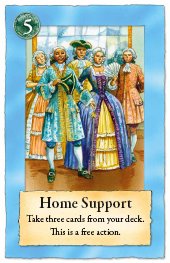 Home Support - Ancestral Recall is possibly the most powerful of the truly broken old school Magic cards. Drawing three cards in one card has always held a lot of appeal for me as a result in pretty much every game I've played since then. It certainly deserves a closer look. In Campaign Manager 2008 it's one of the keys to the truly abusive 'infinite' deck strategy. In Netrunner it was merely a decent card. In Netrunner you could always spend an action to draw a card and only got 4 actions per turn. Spending an action and a card for 3 cards is better than spending an action for 1 card but it wasn't overpowered. In AFAoS the home support card has the added bonus of not even taking one of your two actions! But on the other side of things you always fill your hand back up to 5 cards at the end of the turn. There are no other ways to draw cards so the best you can expect is to have a 7 card hand on your turn instead of a 5 card hand. But then if you spend 3 cards on your turn you'll only draw 1 card at the end of your turn in stead of 3. You net 2 cards right away but end up down 2 cards at the end of the turn. Since it didn't cost you an action and might give you more options that's still ok. Even better you might be able to spend more than 3 cards in your 2 actions and truly gain as a result. The French in particular want to set up a huge trader and home support can do that. It can also backfire when you end up with 7 cards without a trader and are stuck with bad actions while you try to get below a 5 card hand to draw more cards...
There's another thing to keep in mind with home support which is that the card got substantially nerfed with the version 2 rules changes. You can only reshuffle your discard pile into your deck at the end of your turn so if you only have two cards left in your deck when you play home support you only get those two cards. If you have no cards at all you can't even play it on Yucata. (It is unclear to me if that is the way it should work or not. I like the idea of being able to discard it for no action cost.) This makes home support worse if you happen to shuffle it to the bottom of your deck. You can't both get the full 3 cards out of it and reshuffle it into your deck to play it next time through. Probably you're better off just holding it until the reshuffle happens but even then you're playing your current turn with a completely dead card. Drawing it with no cards left in your deck is painful because there's no way to get around only have a 4 card hand for the turn.
Home support actually has an interesting use in a 5 card deck. It means you can buy a military card (going up to a 6 card deck) and be guaranteed to draw the military card on your next turn. (Assuming you play a card and therefore have to reshuffle at end of turn, anyway.) You'll only have one card left in your deck after drawing at the end of the turn and thanks to pigeonholes that card can't be both the military card and the home support! This is relevant because your opponent can't possibly ambush the military card if it stays in your deck. They now have to risk wasting an action to try to kill it off. And if you have a single blocker in your hand they're stuck with the choice of wasting an action, or spending two actions to kill it, or letting you play the military card next turn. All three of these options are bad for them.
Home support can be very useful in a small deck as well if you're lucky enough to keep drawing it early in the shuffle. Especially for the British who will often have a deck capable of a 6 gold merchant action if they draw up to 7 cards! Burning through your deck faster with home support can also let you redraw your best card more frequently than you 'should' be able to. (Typically if I'm doing this it's so I can keep cycling my rangers card on ambushes/raids/blocks.)
Home support does cost 5 bucks to buy so it's not a given that every deck should have one. It tends to make your draws smoother but sometimes actually makes them worse. That said, I do tend to buy one in almost every game as either side.
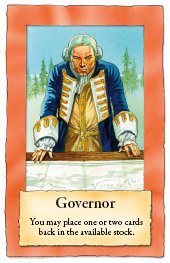 Governor - I think this is the single best card in the game. It looks pretty tame on the surface... You have to spend an action to buy it. You have to draw it with your bad cards at the same time. You have to spend actions to use it. And then when all is said and done you're stuck with the governor in your deck and no way to get rid of it beyond discarding it or storing it in your reserve. It does a lot of the same things the chapel does in Dominion and I can remember getting demolished on Brettspielwelt by someone who made a super thin deck with chapel. Then I remember doing the same thing to my friends. Shrinking your deck down to a size where you can guarantee what your hand will be every turn is incredibly powerful. It lets you adapt to your opponent's strategy in a single turn while they have to cycle through their entire deck 3 to 5 cards at a time until they can reshuffle their new strategy into their deck. It's even more powerful in A Few Acres of Snow since you keep the victory points for locations you own even after purging the card from your deck. And since you can build up money and save it over turns you can even get rid of your money engine but keep buying things if it really comes down to it.
I think practically every deck and every strategy wants a governor. The French military strategy is the one exception since it can actually make use of every starting card in their deck as part of their invasion plan. (The only downside is the British with precise play can always repel a French military attack...) Every British strategy needs a governor. If you're going military you have to get Pemaquid and St Mary's out of your deck as soon as possible since they don't make money or attack. If you're trying to expand then you want to purge locations after you use them to move forward. There's no sense having a 20 card deck and needing to draw 1 specific card to keep going when you can have a 10 card deck and need that same 1 card! If you're trying for a raiding plan you end up settling some truly terrible cards... You need Fort Halifax or Kennebec from which to springboard your raids but keeping a literal blank in your deck is horrible. You only want the cube in play to raid from, the card itself is a detriment and you want to purge it.
A flexible French strategy with a lot of expanding also needs a governor. You need your deck to be slim enough that you can plausibly react to the British plan. A few locations need settlers and you only have the one (Quebec) so having a thinner deck means you'll draw it more often. I've toyed with buying the second trader card and just having a huge deck but you end up losing to any sort of focused British strategy when you have a huge deck.
 Intendant - This is a French only card. I don't know how I really feel about it. I rarely end up buying it and tend to regret buying it when I do. The biggest problem with it is how much it costs for the regrowth effect. 2 bucks and an action is a huge price to pay! It does have some interesting uses. You can buy a card with your first action and then immediately pick it up with your second. (Only really useful with the military leader or a raid/ambush blocker.) You could have bought a military card in a previous turn (or had a fight just end), pick up your siege artillery, and go to town with it. You can use it to run home support a second time. If the French is trying to end the game with disks it can really help to be able to recycle a settler card. It's even quite feasible to take a new location with your first action and then intendant it up as your second action. Then next turn you're ready to disk a location you didn't even have a cube in the turn before! You could also use it to quickly launch invasions. Win a fight in Pemaquid for example, and you can pick it up with your first action and launch an attack on Boston with your second. Assuming you still have military cards in your hand after winning the first siege...
A lot of those scenarios sound cool and powerful but the reality is they just never seem to come up. I've tried to set one up before only to have intendant be the last card of my deck. I ended up reshuffling the turn I drew it which meant I had intendant in my hand and no cards in my discard pile to pick up. It was terrible! Even if they do come up you need to consider if the tempo gain is actually worth it. Do you really need to invade Boston the turn you took Pemaquid? Unless the opponent is going to end the game with another end game condition you almost certainly have enough time to wait.
I had one game where I was able to home support, intendant it back, home support, and then trader for 12. That was pretty sweet. And then I reshuffled my deck and drew the intendant but not the home support or the trader and had to spend several turns discarding cards and doing nothing. That was less sweet...
There's another thing to keep in mind with home support which is that the card got substantially nerfed with the version 2 rules changes. You can only reshuffle your discard pile into your deck at the end of your turn so if you only have two cards left in your deck when you play home support you only get those two cards. If you have no cards at all you can't even play it on Yucata. (It is unclear to me if that is the way it should work or not. I like the idea of being able to discard it for no action cost.) This makes home support worse if you happen to shuffle it to the bottom of your deck. You can't both get the full 3 cards out of it and reshuffle it into your deck to play it next time through. Probably you're better off just holding it until the reshuffle happens but even then you're playing your current turn with a completely dead card. Drawing it with no cards left in your deck is painful because there's no way to get around only have a 4 card hand for the turn.
Home support actually has an interesting use in a 5 card deck. It means you can buy a military card (going up to a 6 card deck) and be guaranteed to draw the military card on your next turn. (Assuming you play a card and therefore have to reshuffle at end of turn, anyway.) You'll only have one card left in your deck after drawing at the end of the turn and thanks to pigeonholes that card can't be both the military card and the home support! This is relevant because your opponent can't possibly ambush the military card if it stays in your deck. They now have to risk wasting an action to try to kill it off. And if you have a single blocker in your hand they're stuck with the choice of wasting an action, or spending two actions to kill it, or letting you play the military card next turn. All three of these options are bad for them.
Home support can be very useful in a small deck as well if you're lucky enough to keep drawing it early in the shuffle. Especially for the British who will often have a deck capable of a 6 gold merchant action if they draw up to 7 cards! Burning through your deck faster with home support can also let you redraw your best card more frequently than you 'should' be able to. (Typically if I'm doing this it's so I can keep cycling my rangers card on ambushes/raids/blocks.)
Home support does cost 5 bucks to buy so it's not a given that every deck should have one. It tends to make your draws smoother but sometimes actually makes them worse. That said, I do tend to buy one in almost every game as either side.
I think practically every deck and every strategy wants a governor. The French military strategy is the one exception since it can actually make use of every starting card in their deck as part of their invasion plan. (The only downside is the British with precise play can always repel a French military attack...) Every British strategy needs a governor. If you're going military you have to get Pemaquid and St Mary's out of your deck as soon as possible since they don't make money or attack. If you're trying to expand then you want to purge locations after you use them to move forward. There's no sense having a 20 card deck and needing to draw 1 specific card to keep going when you can have a 10 card deck and need that same 1 card! If you're trying for a raiding plan you end up settling some truly terrible cards... You need Fort Halifax or Kennebec from which to springboard your raids but keeping a literal blank in your deck is horrible. You only want the cube in play to raid from, the card itself is a detriment and you want to purge it.
A flexible French strategy with a lot of expanding also needs a governor. You need your deck to be slim enough that you can plausibly react to the British plan. A few locations need settlers and you only have the one (Quebec) so having a thinner deck means you'll draw it more often. I've toyed with buying the second trader card and just having a huge deck but you end up losing to any sort of focused British strategy when you have a huge deck.
A lot of those scenarios sound cool and powerful but the reality is they just never seem to come up. I've tried to set one up before only to have intendant be the last card of my deck. I ended up reshuffling the turn I drew it which meant I had intendant in my hand and no cards in my discard pile to pick up. It was terrible! Even if they do come up you need to consider if the tempo gain is actually worth it. Do you really need to invade Boston the turn you took Pemaquid? Unless the opponent is going to end the game with another end game condition you almost certainly have enough time to wait.
I had one game where I was able to home support, intendant it back, home support, and then trader for 12. That was pretty sweet. And then I reshuffled my deck and drew the intendant but not the home support or the trader and had to spend several turns discarding cards and doing nothing. That was less sweet...
Thursday, March 08, 2012
A Few Acres of Snow: Raiding
We've previously covered the mechanics behind ending the game through expansion and through military conquest but there remains one final way to trigger the end of the game. If either player starts their turn with no fight in progress and has stolen at least 12 points worth of stuff from their opponent the game ends and the highest score wins. But where are these 12 points coming from? Primarily by raiding which is today's topic.
Each time you destroy one of your opponent's cities you get to keep the item destroyed. Each cube you steal is worth 2 points. Each disk you steal is worth 4 points. One of the ways to destroy your opponent's stuff if via military attacks. Win a fight in a location and not only do you get the chance to settle it yourself you also get to keep what your opponent had in that spot. (This means he doesn't get set back in terms of ending the game by playing all his cubes since the lost cube is not returned to his supply.) If you're winning a military game you won't be getting up to 12 points of stolen stuff as you should be able to conquer a capital for the instant win long before you get a chance at 12 points. If you're going to end the game in this manner you'll need to do a lot of your destruction via raiding.
The mechanics of raiding are fairly straightforward. Point to an enemy location which you want to raid and count how many spaces away it is from your closest location. (Raiding can make use of rivers, lakes, wagon trails, and the dotted paths on the map.) If that number is 1 or 2 you need to play a single raiding card. If that number is 3 or more then you need to play an extra card for each space beyond 2.
Your opponent now has two options for a response. He can block the raid or can concede defeat. Blocking a raid is similar to blocking an ambush: just play a card that says it blocks a raid. These will be native americans, rangers, coureurs de bois, and fortification cards. In addition they can play the card corresponding to that location to block the raid as well. Conceding defeat of a location with a cube means you take the cube. Conceding defeat of a location with a disk means you take the disk and he puts a cube down in that location. The disk is worth 4 points instead of 2 which is good for you, but he gets to keep using the associated card going forward which is good for them. You do get 2 actions a turn so it is possible to spend both of them raiding the same place twice. First for the disk and then for the cube! 6 points!
Raiding is a tricky thing to evaluate. It costs a lot of money to pay for all the native american uses you need to beat through anything resembling a competent defense. A meticulous opponent can actually become immune to raids entirely since you can't raid a fortified location and you also can't raid beyond a fortified location. I don't like focusing on the raiding game as I find it bogs your deck down if it fails and it can be too easily countered. That said, sometimes your opponent doesn't position himself to counter it quickly and you can deal a crippling blow to your opponent.
A strategy Andrew came up with for the British is to quickly expand towards Quebec and try to successfully raid it twice. If you manage to do so you turn the Quebec card off which has the only settler icon in the French deck. If you follow that up by buying the two neutral settler cards the game is practically over. The French can't put any disks into play which limits their scoring options. They can't settle any locations with a settler icon on them which further reduces their ways of scoring points. Most importantly they can't settle Pemaquid or Albany which means they can't attack a British capital. Since he told me about it I've managed to pull it off a couple times and my opponents have conceded after a couple turns when they realized they have no chance to win anymore.
Another thing you can try to do is raid away Trois Rivieres. Because of the way connections work down there everything west of Quebec connects through Trois Rivieres so you end up turning off every card in the French deck that branches west. Sometimes this will be half or more of your opponent's deck!
Just like with ambushing the French have a large advantage in the raiding game. Their militia can block raids. They have an empire specific native americans card. They have two priests to the British one indian leader. Another advantage the French have that isn't immediately obvious is they start with more points in play. Raiding, if it works, is one of the fastest ways to end the game and they start in a position that wants an early end to the game. I have been in a position as the British where I could successfully raid a location but would lose the game if I did since I'd trigger end game while having fewer points than my opponent.
I do frequently find myself getting into a raid based endgame as the French. Games I play will often have a long, drawn out siege in one location. We'll both have a very thin deck and my opponent will buy neutral native americans cards to try to stop my ambushes. I'll buy a priest and work to take all his native americans. Eventually the siege will end (typically in a British victory) and my back will be against the wall. The British will have a huge military deck and I'll have a huge native americans deck. So I'll ambush a few times to get him under control and then raid with the rest of them. It seems to work reasonably well. You just have to be very careful to have a huge stockpile of cash leading into that stage of the game. I have lost games where I have no money and a hand full of (now useless) native americans cards.
It's very important to track your opponent's hand and deck contents if you're going to try to pull this off. Wasting time and money on raids when they have the location card in hand for the block is painful. Sometimes tracking their hand can help in that you want to make them block with a location! (If they need that location card to launch a siege on Quebec, for example, and you just want to buy some time!)
Like everything else in the game raiding can be very powerful if your opponent doesn't make the right moves to block it. Raiding might even be the swingiest of all the strategies since it can completely destroy your opponent's ability to play the game if implemented properly but is also the easiest plan to counter. Fortification cards are cheap to buy and relatively cheap to put on the map. It's worth playing around with for sure but personally I've found it's a little too easy to block.
Each time you destroy one of your opponent's cities you get to keep the item destroyed. Each cube you steal is worth 2 points. Each disk you steal is worth 4 points. One of the ways to destroy your opponent's stuff if via military attacks. Win a fight in a location and not only do you get the chance to settle it yourself you also get to keep what your opponent had in that spot. (This means he doesn't get set back in terms of ending the game by playing all his cubes since the lost cube is not returned to his supply.) If you're winning a military game you won't be getting up to 12 points of stolen stuff as you should be able to conquer a capital for the instant win long before you get a chance at 12 points. If you're going to end the game in this manner you'll need to do a lot of your destruction via raiding.
The mechanics of raiding are fairly straightforward. Point to an enemy location which you want to raid and count how many spaces away it is from your closest location. (Raiding can make use of rivers, lakes, wagon trails, and the dotted paths on the map.) If that number is 1 or 2 you need to play a single raiding card. If that number is 3 or more then you need to play an extra card for each space beyond 2.
Your opponent now has two options for a response. He can block the raid or can concede defeat. Blocking a raid is similar to blocking an ambush: just play a card that says it blocks a raid. These will be native americans, rangers, coureurs de bois, and fortification cards. In addition they can play the card corresponding to that location to block the raid as well. Conceding defeat of a location with a cube means you take the cube. Conceding defeat of a location with a disk means you take the disk and he puts a cube down in that location. The disk is worth 4 points instead of 2 which is good for you, but he gets to keep using the associated card going forward which is good for them. You do get 2 actions a turn so it is possible to spend both of them raiding the same place twice. First for the disk and then for the cube! 6 points!
Raiding is a tricky thing to evaluate. It costs a lot of money to pay for all the native american uses you need to beat through anything resembling a competent defense. A meticulous opponent can actually become immune to raids entirely since you can't raid a fortified location and you also can't raid beyond a fortified location. I don't like focusing on the raiding game as I find it bogs your deck down if it fails and it can be too easily countered. That said, sometimes your opponent doesn't position himself to counter it quickly and you can deal a crippling blow to your opponent.
A strategy Andrew came up with for the British is to quickly expand towards Quebec and try to successfully raid it twice. If you manage to do so you turn the Quebec card off which has the only settler icon in the French deck. If you follow that up by buying the two neutral settler cards the game is practically over. The French can't put any disks into play which limits their scoring options. They can't settle any locations with a settler icon on them which further reduces their ways of scoring points. Most importantly they can't settle Pemaquid or Albany which means they can't attack a British capital. Since he told me about it I've managed to pull it off a couple times and my opponents have conceded after a couple turns when they realized they have no chance to win anymore.
Another thing you can try to do is raid away Trois Rivieres. Because of the way connections work down there everything west of Quebec connects through Trois Rivieres so you end up turning off every card in the French deck that branches west. Sometimes this will be half or more of your opponent's deck!
Just like with ambushing the French have a large advantage in the raiding game. Their militia can block raids. They have an empire specific native americans card. They have two priests to the British one indian leader. Another advantage the French have that isn't immediately obvious is they start with more points in play. Raiding, if it works, is one of the fastest ways to end the game and they start in a position that wants an early end to the game. I have been in a position as the British where I could successfully raid a location but would lose the game if I did since I'd trigger end game while having fewer points than my opponent.
I do frequently find myself getting into a raid based endgame as the French. Games I play will often have a long, drawn out siege in one location. We'll both have a very thin deck and my opponent will buy neutral native americans cards to try to stop my ambushes. I'll buy a priest and work to take all his native americans. Eventually the siege will end (typically in a British victory) and my back will be against the wall. The British will have a huge military deck and I'll have a huge native americans deck. So I'll ambush a few times to get him under control and then raid with the rest of them. It seems to work reasonably well. You just have to be very careful to have a huge stockpile of cash leading into that stage of the game. I have lost games where I have no money and a hand full of (now useless) native americans cards.
It's very important to track your opponent's hand and deck contents if you're going to try to pull this off. Wasting time and money on raids when they have the location card in hand for the block is painful. Sometimes tracking their hand can help in that you want to make them block with a location! (If they need that location card to launch a siege on Quebec, for example, and you just want to buy some time!)
Like everything else in the game raiding can be very powerful if your opponent doesn't make the right moves to block it. Raiding might even be the swingiest of all the strategies since it can completely destroy your opponent's ability to play the game if implemented properly but is also the easiest plan to counter. Fortification cards are cheap to buy and relatively cheap to put on the map. It's worth playing around with for sure but personally I've found it's a little too easy to block.
Friday, March 02, 2012
A Few Acres of Snow: Ambushing
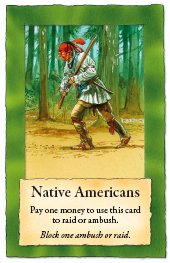 As discussed last time a very strong strategy in A Few Acres of Snow is to focus on military power and just conquer the other player's capital. The British have an advantage because their available cards simply have more strength combined than the French cards. Given infinite money and time for both sides the British will just win any military fight. Those may seem like extreme givens but the way the game plays out they're actually pretty reasonable. In a straight military fight it takes pretty much the same amount of time and resources to defend as it does to attack and the British can manipulate the game state such that they can get a powerful money engine going quickly. The French can try to compete by making money and buying military too but they're guaranteed to lose that fight since they have no way to get an edge and their available cards are just worse. They can try to compete by ignoring military and trying to expand but if you don't try to defend you lose every fight the turn they announce it and there's no way I can see to expand in time. There is one other option to combat military power: ambushing.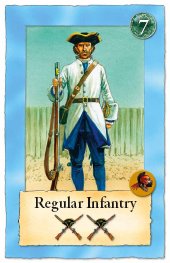
- They can reveal a card which is vulnerable to ambush (indicated by the Indian head shown on the regular infantry card on the right) and return it to their supply. They can buy the card back later if they have the money and want to spend and action but for the time being they lose access to that card. Any card in their hand or reserve can be hit.
- They can reveal their entire hand and reserve to prove that they don't have any ambushable cards at the moment. You don't get a refund of your card, buck, or action. They're just wasted. On the plus side you do get to know he precise contents of their hand.
- They can play a card which blocks ambushes. You'll note the Native Americans card above also says it can block ambushes. Note there is no cost to do so. They don't have to pay a dollar. They don't lose an action on their next turn. The only potential cost is they'll only have 4 cards in their hand for their next turn.
This seems like it could be pretty powerful, right? The only to fight a deck full of ambushing cards would seem to be a deck full of blocking cards? Well, not quite. It turns out there are another class of cards which help out and there are some negative side effects to the whole ambushing game.
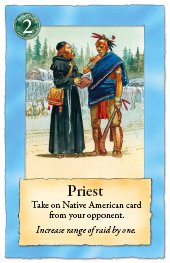
First of all, what is the other way to fight ambushes? Priest for the French and Indian Leader for the British. The two are functionally equivalent. You play one as an action and then if your opponent has one of the green Native American cards in their hand they have to give it to you. Otherwise they have to show you their hand. Both can be useful things to have happen especially since there is no monetary cost to playing the Priest. They can also be used in raids which will be covered in the next post.
What about negative side effects? Well, they clog up your deck is the biggest problem. The British deck functions best when it can draw a full merchant action every turn which uses up 3 of its 5 card hand. The French deck earns most of its money from the trader action which is best with a full 5 card hand of optimal cards. Every ambush card you draw reduces the chance of having an optimal money action which sets you further and further behind your opponent. Especially when you consider that the ambushes rarely even get you ahead in the first place...
What do I mean by that? Well, assume an optimal British engine. They make 6 bucks with their first action each turn. Their second action is to either buy a regular infantry for 7 or to play it into the active combat. Pretend you're the French and have unlimited access to ambushing cards. You spend an action and a buck to kill off their infantry every time they buy one. It took 1.14 actions to make the money and 1 action to buy the card so they're losing 2.14 actions when you hit an ambush successfully. Assuming you're making 5 dollars per action that's only costing you 1.2 actions which is a pretty good gain. Keep this up long enough and you'll have enough spare actions to actually win the game some other way. But now give the British a single blocking card. Now it costs you 2 actions and 2 dollars to kill their infantry. That's 2.4 actions which means you're actually losing ground! There is one ambush card which is free to play so you can get that down to 2.2 but it's still not helping your cause at all. Ambushing against a properly set up engine doesn't help. You can ambush after they win a fight, though, which can help.

How do the different sides approach ambushing? Well, this is one area of the game where the French have a huge advantage. They have a blue Native American card which means that it can't be hit by the Indian Leader and that they have access to one more ambusher total. The French have access to 2 Priests compared to the 1 Indian Leader the British have. The French Militia cards actually block ambushes and raids while the British Militia are vulnerable to ambush. Beyond that they each have access to the 5 neutral Native Americans and they each have an ambusher that is free. (Rangers and Coureurs de Bois.)
Ambushing is a great way for a wise French player to abuse the mistake a British player makes but I have yet to find a way for ambushing to actually beat a top notch British plan. It can slow them down a little for sure, and I definitely need more experimentation to see if I can find a way to use that extra time to end the game as the French, but as it stands right now it doesn't seem good enough. The constant drain on gold by ambushing over and over just seems to be too much of a cost.
Ambushing does also give hand information and someone who properly tracks the contents of the opponent deck and hand will make better use of it than someone who doesn't pay attention. I keep playing against opponents who buy an Indian Leader when I don't have any neutral Native Americans, for example. Or people who ambush when I don't own a vulnerable card in my deck. Maybe they're doing it to gain the information themselves? More likely they're just making a mistake.
Wednesday, February 22, 2012
A Few Acres of Snow: Combat
Ok, so now we know how to go around expanding on the board, building more cities, adding cards to our deck, and scoring points. That's all well and good but what if we want to punch the other person in the face? Successfully invading the enemy capital is one of the victory conditions, after all, and doing so completely ignores all those fancy points scored through expanding. How does that work?
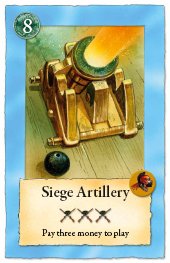 Starting a fight is very similar to expanding into an empty space on the board. You need to have a card for an adjacent spot on the board and you need to have a card for the appropriate mode of transportation. Those two cards get discarded as normal. On top of them you need a third card with military strength on it. This card gets set aside into a 'fighting' zone and won't get back into your deck until the fight resolves. Military strength is indicated by a crossed musket icon. (Also, coastal cities can be attacked by ships so either player can play a card with a ship icon as though it were 1 strength.) The siege artillery card on the right here has 3 of them, for example. Once a fight has been started each player can then use an action to add another card with military strength to the fight. The absolute amount of strength added doesn't matter; it's the relative difference between the two which counts. There's a track on the board representing this 'tug of war' strength difference.
A fight ends if when you start your turn the tug of war marker indicates that you've won the fight. If you're the attacker this means you have at least 2 more strength than your opponent. If you're the defender this means you have at least 1 more strength than your opponent. When a fight ends the loser has to destroy a non-location card (if any) from the fight then the rest of the cards played by both sides go to the discard piles. In addition if the attacker won the fight they can immediately settle the location as a free action. If the location has a settler symbol on it then they need to play a settler card to do so. Otherwise they can take it for free.
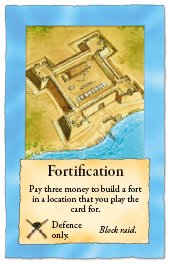 On top of needing a smaller difference to win a fight the defender has a couple other advantages as well. Every city has 1 military strength by default. Some of the cities have additional strength shown on the board. The two British capitals (Boston and New York) have 1 bonus strength each. The starting French cities Louisbourg and Montreal also have 1 bonus strength each and the French capital (Quebec) has two bonus strength. Furthermore if you plan ahead you can build a fort in a city which blocks all raids and gives an extra 2 military strength to the city. Finally the same fortification card can be used as a military strength but only on defense.
The defender has a couple disadvantages. The first is while the fight is taking place the location card for that city becomes unplayable. Having a dead card in your deck is pretty bad. The second is that you don't get to choose when the fight happens so you need to be constantly prepared to defend yourself lest you get blown up.
 Each side has access to one card with 3 strength, a few cards with 2 strength, and some cards with 1 strength. One of those cards, the military leader, doesn't take an action to play. As such the most a player can possibly throw into a fight on a single turn is 6. (Their 3, a 2, and the free 1.) Even if someone happens to draw a hand full of military strength they can only play 2 cards into a fight per turn which tends to give their opponent time to draw more military cards too. So while it is certainly possible for someone to get blitzed out in a single attack it turns out with proper planning (using the reserve to store a couple of military cards should your opponent happen to have a deck with lots of military cards in it) you tend to be able to avoid instantly losing. Most fights seem to go the distance where both players get enough time to eventually put every card they want into the fight. As such fights frequently come down to who has managed to get the most total strength into their deck. Military cards are rather expensive so this tends to be the person with the better money engine but sometimes both players actually get to buy all their military cards. Who wins then?
Well, the French have 1 siege artillery, 4 regular infantry (worth 2 each), 3 militia, a military leader, a coureurs de bois, Montreal, and Quebec. If the fight is at sea (and I can count on one hand the number of fights in 99 games finished that didn't take place at sea) they can also potentially include Port Royal, Halifax, Louisbourg, and their single ships card. On defense they could also have 1 normal fortification and 2 neutral fortification cards.
How about the British? They have 1 siege artillery, 7 regular infantry, 3 militia, a military leader, a rangers, Boston, and New York. At sea they also have New Haven, Norfolk, Port Royal, Halifax, and two ships cards. On defense they have 1 normal fortification and 2 neutral fortification cards.
It should be pretty apparent that the British have a huge advantage here. They have 3 extra regulars and potentially 2 more ships. Note that some of those ships overlap (they can't both own Halifax or Port Royal) but even in a worst case scenario the British have as many ships as the French. They basically can't lose a fight on defense with all their cards and are guaranteed to win on offense unless the French manage to fortify in advance and buy both neutral fortification cards. The British just have inevitability on their side. Their deck costs a lot more (the French pay 21 for their 4 regulars and the British have to pay 49 for their 7) but their money engine is easier to put together so it tends to come out ok for them.
One things to point out is that the British path to Quebec involves conquering spaces with ships on them. This means it's actually easier for the British to win future fights once they start winning fights. Especially since the loser of a fight loses a card on defense! Your deck started with at least 3 more strength than your opponent and they lost a card. You gained a card with a ship on it. And they lose access to the card for the next space you attack. This tends to make for snowballing attacks. It works the other way, too. If the French get started attacking and the British don't properly defend then they'll get snowballed too.
How do you defend? Well, you need to match them military card purchase for military card purchase. Since the attacker only needs 3 more strength in their deck to win every fight it only really takes 2 regular infantry to win the game. If your opponent buys one you might be ok but if they buy a second one and you don't respond you just lose. There is one other way to fight back which is via ambushes which will be covered in the next post.
A fight ends if when you start your turn the tug of war marker indicates that you've won the fight. If you're the attacker this means you have at least 2 more strength than your opponent. If you're the defender this means you have at least 1 more strength than your opponent. When a fight ends the loser has to destroy a non-location card (if any) from the fight then the rest of the cards played by both sides go to the discard piles. In addition if the attacker won the fight they can immediately settle the location as a free action. If the location has a settler symbol on it then they need to play a settler card to do so. Otherwise they can take it for free.
The defender has a couple disadvantages. The first is while the fight is taking place the location card for that city becomes unplayable. Having a dead card in your deck is pretty bad. The second is that you don't get to choose when the fight happens so you need to be constantly prepared to defend yourself lest you get blown up.
Well, the French have 1 siege artillery, 4 regular infantry (worth 2 each), 3 militia, a military leader, a coureurs de bois, Montreal, and Quebec. If the fight is at sea (and I can count on one hand the number of fights in 99 games finished that didn't take place at sea) they can also potentially include Port Royal, Halifax, Louisbourg, and their single ships card. On defense they could also have 1 normal fortification and 2 neutral fortification cards.
How about the British? They have 1 siege artillery, 7 regular infantry, 3 militia, a military leader, a rangers, Boston, and New York. At sea they also have New Haven, Norfolk, Port Royal, Halifax, and two ships cards. On defense they have 1 normal fortification and 2 neutral fortification cards.
It should be pretty apparent that the British have a huge advantage here. They have 3 extra regulars and potentially 2 more ships. Note that some of those ships overlap (they can't both own Halifax or Port Royal) but even in a worst case scenario the British have as many ships as the French. They basically can't lose a fight on defense with all their cards and are guaranteed to win on offense unless the French manage to fortify in advance and buy both neutral fortification cards. The British just have inevitability on their side. Their deck costs a lot more (the French pay 21 for their 4 regulars and the British have to pay 49 for their 7) but their money engine is easier to put together so it tends to come out ok for them.
One things to point out is that the British path to Quebec involves conquering spaces with ships on them. This means it's actually easier for the British to win future fights once they start winning fights. Especially since the loser of a fight loses a card on defense! Your deck started with at least 3 more strength than your opponent and they lost a card. You gained a card with a ship on it. And they lose access to the card for the next space you attack. This tends to make for snowballing attacks. It works the other way, too. If the French get started attacking and the British don't properly defend then they'll get snowballed too.
How do you defend? Well, you need to match them military card purchase for military card purchase. Since the attacker only needs 3 more strength in their deck to win every fight it only really takes 2 regular infantry to win the game. If your opponent buys one you might be ok but if they buy a second one and you don't respond you just lose. There is one other way to fight back which is via ambushes which will be covered in the next post.
Subscribe to:
Posts (Atom)